Skip to content
Evidence Guide
15 min read

Anxiety & Worry

Most childhood worry is ordinary and passes. This guide is about telling the difference — what anxiety is, how it shows up when a child cannot name it, what genuinely helps, and when to involve someone else.

Reading time
15 min read
Age range
All primary (EYFS–KS2)
Evidence level
Moderate
A quiet primary school cloakroom with a single coat and book bag on a wooden peg rail in soft morning light.
OverviewFor teachers

What you may notice in class

  • A child who will not start, particularly when the task is open-ended or the answer might be wrong.
  • Frequent trips to the toilet or the medical room, often clustered before the same lesson.
  • Repeated checking questions: "Is this right?", "What do I do now?", after the answer has been given.
  • Reluctance to speak in front of the class, or to read aloud, that does not match their ability.
  • Difficulty at arrival, changes of adult, wet play, assembly, the hall, PE changing.
  • Withdrawal from a group, or hovering at the edge of a game.
  • Work that is heavily rubbed out, restarted, or never finished because it is not good enough.
  • Irritability, refusal or leaving the room — anxiety does not always look anxious.

Pattern matters more than incident. The same difficulty in every lesson and the same difficulty only in writing, or only after lunch, are different pieces of information.

OverviewFor teachers

What it is easily mistaken for

Anxiety is frequently read as low ability, lack of effort, poor behaviour or attention difficulty. A child who cannot start looks unmotivated; a child who leaves the room looks defiant; a child who cannot hold information while worried looks as though they were not listening.

It runs the other way too, and this matters just as much. Not every reluctance is anxiety. Work pitched too high, instructions too long to hold, an unfamiliar word, a hearing difficulty, a friendship falling out or simple boundary-testing all produce similar surfaces. Checking task demand and language load first is not a detour; it is often the answer.

Careful with the word

Once 'anxious' is written on a record it tends to travel and to explain everything the child does afterwards. Describe what you saw, when, and what preceded it. Interpretation can come later, from someone qualified to make it.

MoreFor teachers

Anxiety and learning

Worry occupies the same limited attention and working memory that the task needs. A child spending a lesson managing a feeling has less capacity for the content, which is why work sometimes falls far below what you know they can do — and why they can appear to have forgotten something they knew yesterday.

Assessment is particularly affected. Timed work, being called on, reading aloud and anything with a public outcome will underestimate an anxious child. If you want to know what they know, ask in a low-stakes way.

OverviewFor teachers

What helps, and is realistic for a class of thirty

Predictability

What it is: the day's shape visible, the same routines, warning before change, clear endings. Why it may help: much anxiety is about uncertainty, and classroom uncertainty is largely removable at no cost.

A reliable way in to every task

What it is: a worked example, a first sentence, a model, a partner. Why: the blank start is where anxious children stall. It also helps everyone else.

Remove the public risk, not the expectation

What it is: warn before you call on them, agree a signal, let them rehearse an answer with a partner first, take the answer privately. Why: the fear is usually about being seen to fail, not about the work.

Answer the checking question once

What it is: a brief answer, then a consistent line — "You've got what you need, have a go and I'll look in two minutes." Why: repeated reassurance is comforting and habit-forming. Limits: only workable if you do come back.

Plan the seams of the day

Why: arrival, transitions, lining up, playtimes, assembly and home time cause more difficulty than lessons and are usually the least planned parts. What it looks like: a job on arrival, a defined role at tidy-up, a known place to be at playtime.

An agreed exit that is not a sanction

What it is: a dignified, time-limited way to take a break — an errand, a named adult, a specific place. Why: it prevents escalation and keeps the child in the day. Limits: agree it in advance and watch that it does not become avoidance of one subject.

Be one of the reliable adults

What it is: greeting them by name, brief non-task contact daily, noticing when they manage something hard. Why: NICE identifies trusted relationships and a supportive school climate as the foundation of wellbeing provision.

MoreFor teachers

Talking to a worried child

  • Short, calm, quiet, and out of earshot of the class.
  • Ask what would make the next ten minutes manageable, not what is wrong with them.
  • Offer two acceptable options rather than an open question.
  • Do not require eye contact or an explanation on the spot.
  • Say what will happen next, so the immediate future is known.
  • Follow up briefly later — that is what makes it a relationship rather than an incident.
Practical ideasFor teachers

Things to avoid

  • Public discussion of a child's worry, or of an adjustment being made for them.
  • Insisting on participation in the moment as a matter of principle.
  • Long reasoning while the child is overwhelmed.
  • Removing the child from the parts of the day they enjoy as a consequence.
  • Treating a persistent pattern as something to manage alone — loop in the SENDCO or pastoral lead.
  • Assuming a quiet, compliant, high-achieving child is fine.
MoreFor teachers

Working with families and colleagues

Parents often see a very different child at 4pm than you see at 11am. If a family reports difficult mornings or distressing evenings and you see nothing, both accounts are usually accurate — it means school is costing more than it appears.

Involve the SENDCO or pastoral lead when a pattern persists across contexts despite adjustments, when attendance or participation is being affected, when a child is very distressed, or when you are unsure. Bring examples: date, lesson, what preceded it, what helped.

ResearchFor teachers

Evidence & sources

What this guide is, and is not

This is an educational guide, not a clinical one. It cannot tell you whether a child has an anxiety disorder, and nothing here replaces advice from a GP or a mental health service. The school-side evidence is moderate at best — the EEF rates social and emotional learning as moderate impact on moderate evidence — so what follows is written as 'likely to help', not 'proven to work'.

  1. NHSProfessional guidance
    Anxiety in children — advice for parents

    The plainest UK statement of the distinction this guide rests on: all children feel worried sometimes, and anxiety becomes a concern when it is out of proportion, persistent, and getting in the way of ordinary life.

  2. NHSProfessional guidance
    Anxiety disorders in children

    Describes recognised anxiety difficulties and the routes to help — GP first, then local children and young people's mental health services. Diagnosis sits here, not with schools.

  3. NHSProfessional guidance
    Children and young people's mental health — advice for parents

    The parent-facing hub, including what to do first and where support exists locally.

  4. National Institute for Health and Care ExcellenceProfessional guidance
    Social, emotional and mental wellbeing in primary and secondary education (NG223) (2022)

    Recommends a whole-school approach: supportive climate, trusted relationships, universal curriculum content, targeted support for those who need more, and staff training to deliver it.

  5. National Institute for Health and Care ExcellenceProfessional guidance
    Social anxiety disorder: recognition, assessment and treatment (CG159) (2013)

    Clinical guidance covering children and young people. Referenced here only to be clear where the clinical threshold and treatment decisions sit — with health services.

  6. Department for EducationProfessional guidance
    Mental health and behaviour in schools (2018)

    Non-statutory advice on the line between what a school can reasonably provide and what needs a clinical service — the question most often at issue with anxiety.

  7. Department for EducationProfessional guidance
    Mental health issues affecting a pupil's attendance: guidance for schools (2023)

    Directly addresses anxiety-related absence: attendance is usually improved by support and adjustment alongside expectation, rather than enforcement alone.

  8. Department for EducationStatutory guidance
    Working together to improve school attendance (2022, statutory from 2024)

    Sets out the 'support first' expectation and the duties schools and local authorities hold where attendance is affected by health or SEND.

  9. Department for EducationStatutory guidance
    SEND Code of Practice: 0 to 25 years (2015)

    Names anxiety as an example of a social, emotional and mental health need, and sets out the graduated approach — assess, plan, do, review.

  10. Department for Education (research by University College London)Research evidence
    Identifying and supporting children and young people with social, emotional and mental health needs: a rapid evidence review (2025)

    Part of the DfE's SEND evidence programme. Published as research; the DfE states it does not endorse the approaches described.

  11. Education Endowment FoundationResearch summary
    Improving Social and Emotional Learning in Primary Schools — guidance report (2019, updated 2021)

    Recommends teaching social and emotional skills explicitly and using them across the day. Rated by the EEF as moderate impact for very low cost, on moderate evidence.

  12. Public Health England / Department for EducationProfessional guidance
    Promoting children and young people's mental health and wellbeing: a whole-school and whole-college approach (2021)

    The eight-principle framework most UK schools audit their wellbeing provision against.

  13. Anna FreudProfessional guidance
    Mentally Healthy Schools

    Quality-assured UK resource bank for primary schools — useful when choosing classroom materials that are not simply commercial products.

Supporting Families
Looking for a parent-friendly version of Anxiety & Worry?

The Kind Learner Space has this guide in plain English for families — the same evidence, translated for home.

Open in The Kind Learner Space
Continue exploring

Where to go next.

A calm handful of next steps — not a checklist. Follow whichever thread is most useful right now.

Related guides

A natural next thread.

For families

Share this at home.

A plain-English version parents and carers can read at home — same evidence, warmer language.

Same category

More in Social, Emotional & Mental Health.

Emotional wellbeing, relationships, regulation, anxiety, trauma and belonging.

You may also find these helpful

Related Evidence Guides

Each guide below connects to the one you've just read. We've noted why — so you can follow the thread that matters most to you.

A stack of well-loved picture books beside a notebook on a wooden desk in soft window light.
Evidence guide · 12 min read

Working Memory

The mental notepad that lets a child hold information in mind long enough to use it — and the small changes that make the biggest difference.

Explore
A pegboard on a classroom wall with wooden name tags in warm afternoon light.
Evidence guide · 14 min read

Executive Function

Planning, flexibility and impulse control — the mental machinery that lets a developing brain get things done.

Explore
An open book and pencil on a classroom desk lit by low morning sunlight through a window.
Evidence guide · 11 min read

Attention

Why this is relevant

Worry occupies the same limited capacity that attention needs, which is why anxious children can look inattentive.

Explore
A quiet primary classroom corner with soft natural light, uncluttered surfaces and calm materials.
Evidence guide · 11 min read

Cognitive Load

Why this is relevant

Task demand is a common and fixable trigger; checking it comes before treating difficulty as emotional.

Explore
A child's small hands holding an autumn maple leaf in soft window light.
Evidence guide · 10 min read

Processing Speed

The pace at which a child takes in, makes sense of and responds to information — and why slower doesn't mean less capable.

Explore
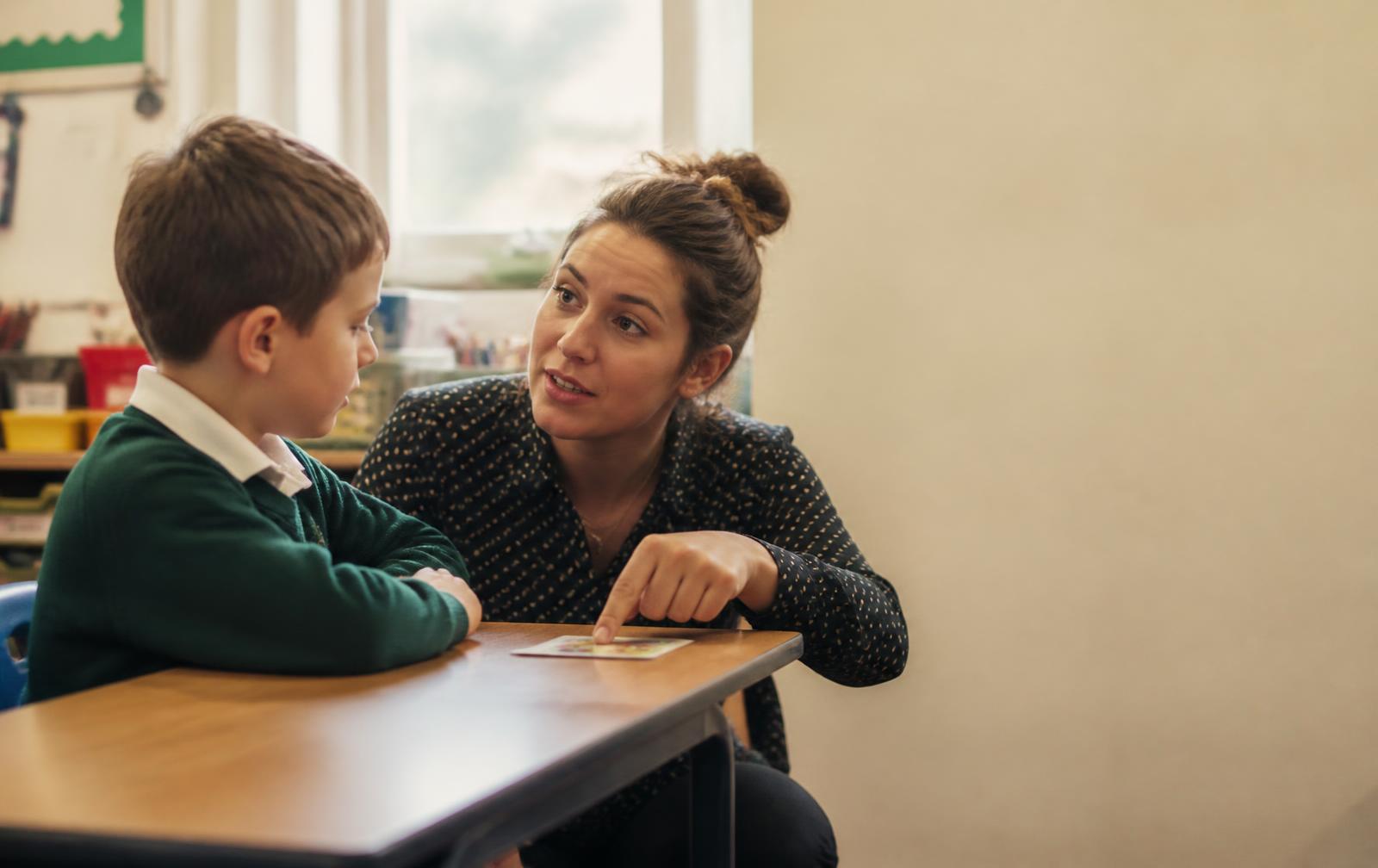
A teacher crouched at eye level beside a young child at a classroom desk, pointing at a small visual card in soft window light.
Evidence guide · 13 min read

Understanding Spoken Language

How children make sense of what adults say — and what we can change about the way we communicate so that more children understand, participate and show what they know.

Explore
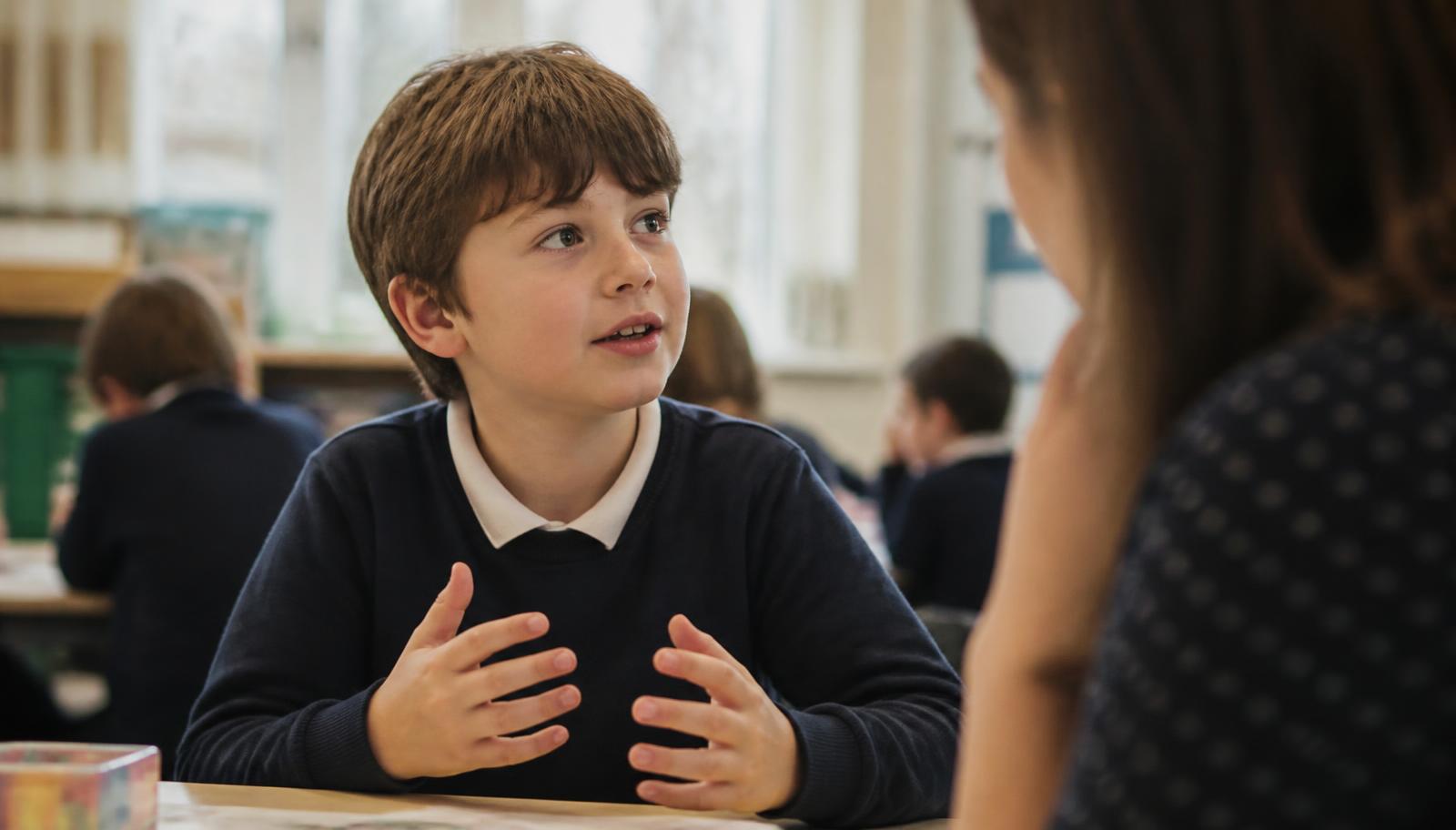
A young primary school child talking animatedly to an adult across a classroom table in soft window light.
Evidence guide · 14 min read

Expressive Language

How children put their thoughts, ideas, needs and experiences into words — and what adults can change so that more children can show what they think and know.

Explore
An adult and a young primary school child sitting side by side over an open picture book in soft window light.
Evidence guide · 14 min read

Vocabulary & Word Knowledge

What it means to really know a word, why word knowledge sits underneath so much classroom learning, and how adults can build it deliberately without turning language into a deficit.

Explore
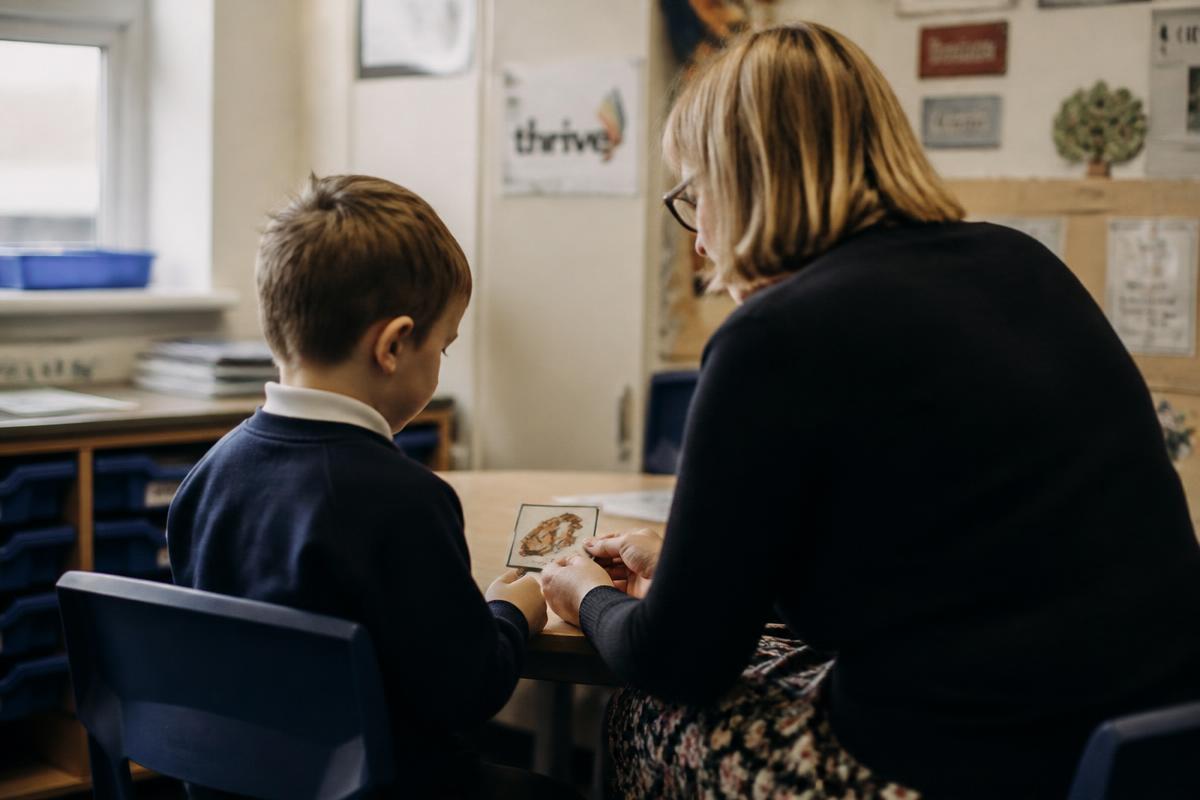
An adult and a young primary school child sitting side by side at a classroom table, looking together at a small picture card in soft window light.
Evidence guide · 14 min read

Speech Sounds & Speech Clarity

Being hard to understand is not the same as having less to say. What speech sounds are, how clarity develops at different rates, and how to keep a child fully included while it does.

Explore
A quiet primary school book corner with a wooden bench, cushions and a basket of picture books beside a window in soft daylight.
Evidence guide · 15 min read

Emotional Regulation

Why this is relevant

Worry is one of the feelings children are learning to manage; this guide covers the wider skill it sits inside.

Explore
A quiet primary classroom carpet area with cushions and a low bookshelf in soft daylight.
Evidence guide · 16 min read

Understanding Behaviour

Why this is relevant

Anxiety often arrives as refusal, walking out or sudden anger — this guide helps read what sits underneath.

Explore
An empty wooden bench beside a primary school playground with a faded chalk hopscotch grid and autumn leaves.
Evidence guide · 15 min read

Relationships & Belonging

Why this is relevant

Feeling known and wanted at school is one of the strongest protections against anxiety about being there.

Explore
An empty primary school desk with a pencil pot and notebook beside a wooden chair with a wobble cushion, in soft morning light.
Evidence guide · 16 min read

ADHD

Attention, impulse and activity are shaped as much by the situation as by the child. This guide looks at what ADHD is, what it is not, and what actually helps in a mainstream primary classroom and at home.

Explore
A quiet corner of a primary classroom with a low wooden shelf of neatly arranged wooden blocks and a folded blanket beside a window.
Evidence guide · 17 min read

Autism

Autism is a difference in how a person communicates, experiences the world and makes sense of it — not a list of deficits. This guide looks at what may be relevant, what the environment contributes, and what genuinely helps in a mainstream primary school.

Explore
An open book resting on a wooden primary school table beside a pencil and reading glasses in soft window light.
Evidence guide · 16 min read

Dyslexia

Dyslexia is about accurate, fluent word reading and spelling — not reversed letters or a visual learning style. This guide separates what is known from what is myth, and sets out the teaching and adjustments that actually help.

Explore
An adult's hand gently holding a young child's hand in soft natural light.
Evidence guide · 13 min read

School Attendance

When getting to school becomes the hardest part of the day. What can sit underneath attendance difficulties, how families and schools can work on it together, and what the guidance actually expects.

Explore
A calm, quiet reading corner in a primary classroom with cushions and soft daylight.
Evidence guide · 11 min read

Transitions

Moving from one thing to the next — between activities, places, people and years. Why change can be so hard for some children, and the calm, predictable preparation that helps.

Explore
Soft natural textures and calm materials arranged in gentle daylight.
Evidence guide · 11 min read

Sensory Needs

Some children experience noise, light, touch, smell or movement more — or less — intensely than others. What that can look like, why it matters for learning and wellbeing, and the calm adjustments that help.

Explore
A tidy wooden desk with a notebook and pencils in soft window light.
Evidence guide · 9 min read

Homework

Making home learning calmer for everyone. What the evidence says about primary homework, why it can be so hard after a long school day, and how families and schools can keep it purposeful rather than painful.

Explore
A parent and child sharing a picture book together in soft, warm light.
Evidence guide · 9 min read

Sleep

Small, steady changes that help a child settle and stay asleep — and why sleep matters so much for learning, mood and coping. Based on NHS advice.

Explore