
Evidence Guide
14 min read

Executive Function

Planning, flexibility and impulse control — the mental machinery that lets a developing brain get things done.

Reading time
14 min read
Age range
All primary (EYFS–KS2)
Evidence level
High
A pegboard on a classroom wall with wooden name tags in warm afternoon light.
Teacher strategiesFor teachers

Adaptive teaching strategies

Externalise the plan

Give pupils a visible plan for the lesson and the task. Reduce what has to be held internally.

Model the process

Think aloud through the task — "first I read the question, then I underline…". You are showing the invisible steps.

Chunk with checkpoints

Break a task into three named stages with clear "done" signals for each.

Rehearse transitions

Signal in advance, name the shift, and give a consistent routine ("pens down, eyes up").

Teach self-talk

Prompt "What do I need to do first?" until the child begins to ask it themselves.

Teacher strategiesFor teachers

Practical classroom approaches

Task-organisation card

A laminated 4-step "how to start" card sitting on the desk removes the friction of a cold start.

Colour-coded books & timetables

Reduces the cost of every equipment switch across a day.

Repair scripts

Model, and rehearse, what to say after an impulsive response — so the child has language ready.

Supporting Families
Looking for a parent-friendly version of Executive Function?

The Kind Learner Space has this guide in plain English for families — the same evidence, translated for home.

Open in The Kind Learner Space
Continue exploring

Where to go next.

A calm handful of next steps — not a checklist. Follow whichever thread is most useful right now.

For families

Share this at home.

A plain-English version parents and carers can read at home — same evidence, warmer language.

Browse by theme

Zoom out.

Sensory, attention, communication, wellbeing — see how this topic sits alongside the wider picture.

Learning pathway

Take the longer route.

Working memory, attention, executive function and cognitive load — threaded into one guided journey.

You may also find these helpful

Related Evidence Guides

Each guide below connects to the one you've just read. We've noted why — so you can follow the thread that matters most to you.

A stack of well-loved picture books beside a notebook on a wooden desk in soft window light.
Evidence guide · 12 min read

Working Memory

Why this is relevant

Working memory is one of the three core executive functions — planning and self-regulation depend on it.

Explore
An open book and pencil on a classroom desk lit by low morning sunlight through a window.
Evidence guide · 11 min read

Attention

Why this is relevant

Sustained and selective attention are the raw materials executive function organises into purposeful action.

Explore
A quiet primary classroom corner with soft natural light, uncluttered surfaces and calm materials.
Evidence guide · 11 min read

Cognitive Load

Why this is relevant

Reducing extraneous load frees the mental resources needed for planning, monitoring and self-regulation.

Explore
A child's small hands holding an autumn maple leaf in soft window light.
Evidence guide · 10 min read

Processing Speed

Why this is relevant

Executive function tasks feel harder when processing is slower — the same demands take more capacity.

Explore
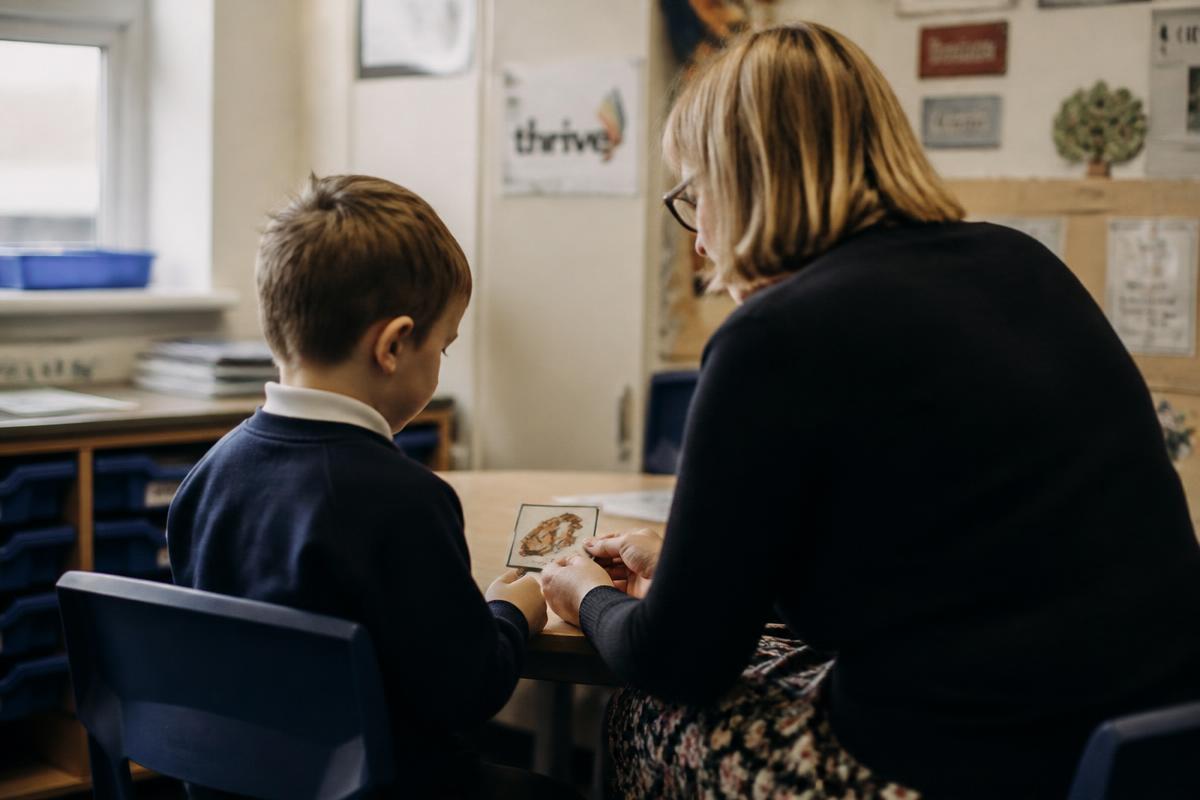
A teacher crouched at eye level beside a young child at a classroom desk, pointing at a small visual card in soft window light.
Evidence guide · 13 min read

Understanding Spoken Language

How children make sense of what adults say — and what we can change about the way we communicate so that more children understand, participate and show what they know.

Explore
A young primary school child talking animatedly to an adult across a classroom table in soft window light.
Evidence guide · 14 min read

Expressive Language

How children put their thoughts, ideas, needs and experiences into words — and what adults can change so that more children can show what they think and know.

Explore
An adult and a young primary school child sitting side by side over an open picture book in soft window light.
Evidence guide · 14 min read

Vocabulary & Word Knowledge

What it means to really know a word, why word knowledge sits underneath so much classroom learning, and how adults can build it deliberately without turning language into a deficit.

Explore
An adult and a young primary school child sitting side by side at a classroom table, looking together at a small picture card in soft window light.
Evidence guide · 14 min read

Speech Sounds & Speech Clarity

Being hard to understand is not the same as having less to say. What speech sounds are, how clarity develops at different rates, and how to keep a child fully included while it does.

Explore
A quiet primary school book corner with a wooden bench, cushions and a basket of picture books beside a window in soft daylight.
Evidence guide · 15 min read

Emotional Regulation

Why this is relevant

Planning and self-monitoring depend on how settled a child feels; the two are usually looked at together.

Explore