Evidence Guide
14 min read

Expressive Language

How children put their thoughts, ideas, needs and experiences into words — and what adults can change so that more children can show what they think and know.

Reading time
14 min read
Age range
All primary (EYFS–KS2)
Evidence level
High
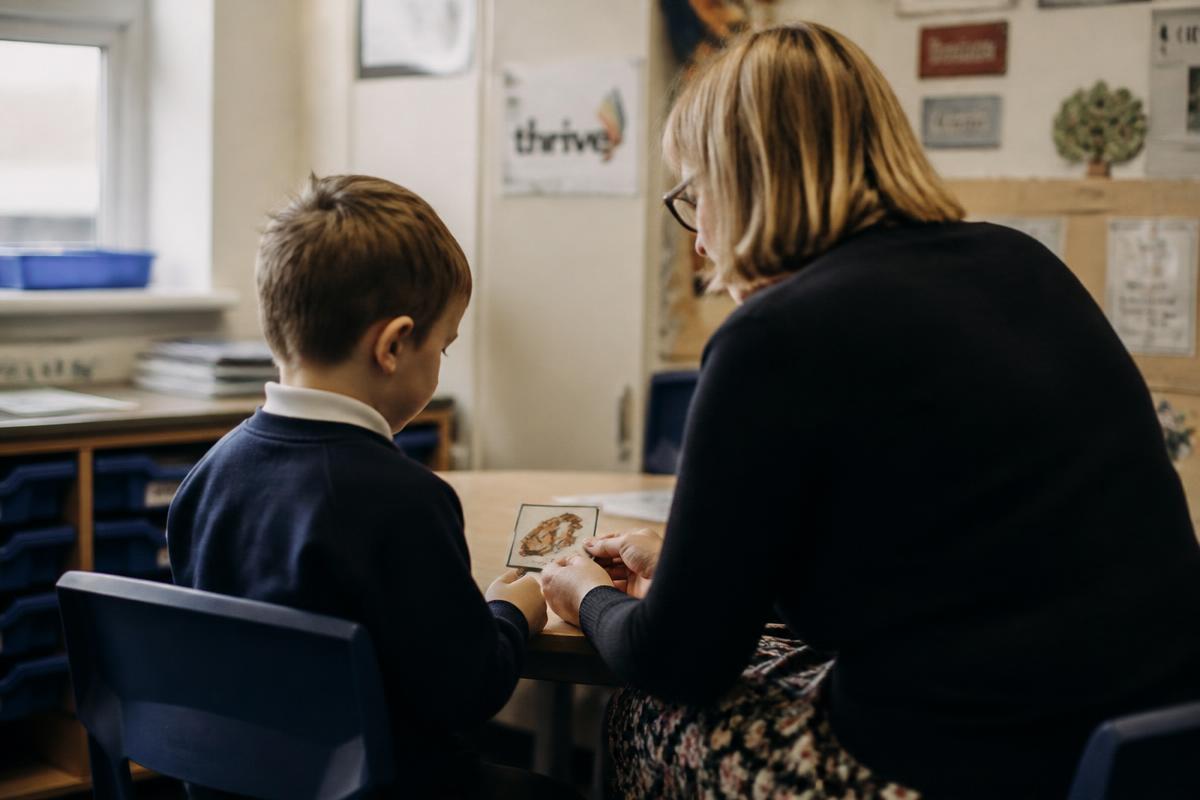
A young primary school child talking animatedly to an adult across a classroom table in soft window light.
Leader guidanceFor leaders

Whole-school implications

If around two children in every class of thirty have a language disorder — the figure the RCSLT draws from Norbury and colleagues' 2016 population study — then expressive language is a mainstream teaching issue in every classroom, not a SEND caseload matter.

  • Expect the same core practices — modelling, structured talk, explicit vocabulary, thinking time — in every classroom, not only where a teacher happens to be interested.
  • Check that assessment practice separates what a child knows from what they can currently express.
  • Make sure quiet children are visible in your identification systems. They are the group most often missed.
  • Treat communication as part of your behaviour policy's thinking, not as an exception to it.
Leader guidanceFor leaders

Staff development

Train on a small number of practices, properly

Recasting, extending, sentence stems and thinking time can be taught in a single session and coached over a term. That is more likely to change practice than a broad awareness INSET.

Include support staff from the start

Teaching assistants deliver much of the targeted talk work in most primary schools and are frequently trained last.

Use the EEF guidance reports as the shared reference

Preparing for Literacy, Improving Literacy in KS1 and in KS2 give a common, credible basis for what the school expects — and are free.

Build in coaching, not just input

Modelling in someone's classroom shifts practice more reliably than a slide deck. Protect the time.

Leader guidanceFor leaders

Curriculum and environment

  • Identify the vocabulary each subject and year group is responsible for teaching, and revisit it deliberately.
  • Design in structured opportunities for purposeful talk — explaining, persuading, presenting — rather than hoping discussion happens.
  • Consider the listening environment: noise, acoustics and seating affect who can take part.
  • Ensure alternative ways of showing learning are accepted across the school, not negotiated case by case.
  • Where children use AAC, signing or symbols, make sure these are visible and used by adults too. The RCSLT is clear that these supports do not delay speech.
MoreFor leaders

Strategic SEND leadership

  • Know your local NHS speech and language therapy pathway, its waiting times, and what you can put in place while families wait.
  • Give the SENDCO sufficient protected time — the SEND Code of Practice frames the role as strategic, and it cannot be done in the gaps.
  • Work with feeder early years settings; communication and language is a prime area of the EYFS and transition information is often lost.
  • Track outcomes for children with identified communication needs separately, and be willing to see what the data shows.
  • Budget for training and for the resources that follow it, rather than for a programme alone.
ResearchFor leaders

Evidence and sources

How to read the evidence

Some of what follows is statutory guidance schools must follow, some is a synthesis of research, and some is professional practice that is widely recommended but not separately trialled. We have tried to say which is which. The EEF rates oral language approaches as high impact for very low cost on extensive evidence — but it has not published separate effect sizes for individual techniques such as sentence starters or extra thinking time. Those sit inside the broader picture; treating any one of them as independently proven would overstate what the evidence shows.

  1. Department for EducationStatutory guidance
    SEND Code of Practice: 0 to 25 years (2015)

    Names communication and interaction — including speech, language and communication needs — as one of the four broad areas of SEN, and sets out the graduated approach schools must follow.

  2. Department for EducationStatutory guidance
    Early years foundation stage statutory framework (current version)

    Communication and language is one of three prime areas; providers must give children a language-rich environment and opportunities to express themselves.

  3. Department for EducationProfessional guidance
    Development Matters: non-statutory curriculum guidance for the EYFS (2023 revision)

    Describes typical progression in listening, understanding and speaking. Explicitly not a checklist, and not statutory.

  4. Education Endowment FoundationResearch summary
    Oral language interventions (Teaching and Learning Toolkit)

    Rates oral language approaches as high impact for very low cost, based on extensive evidence. The Toolkit is periodically revised, so check the live page for the current impact estimate rather than quoting an older figure.

  5. Education Endowment FoundationResearch summary
    Preparing for Literacy: improving communication, language and literacy in the early years (2018)

    Recommends high-quality adult–child interaction and structured language development, and notes the recommendations may also apply to older pupils who have fallen behind.

  6. Education Endowment FoundationResearch summary
    Improving Literacy in Key Stage 1 (2017, updated)

    Places developing pupils' language capability — vocabulary, listening and structured talk — among the foundations of early reading and writing.

  7. Education Endowment FoundationResearch summary
    Improving Literacy in Key Stage 2 (2017, updated 2021)

    Links spoken vocabulary and structured discussion to reading comprehension and writing composition across KS2.

  8. Royal College of Speech and Language TherapistsProfessional guidance
    Clinical information: developmental language disorder (DLD)

    States that DLD affects around 7.6% of children — roughly two in a class of thirty — and describes its impact on understanding and using language.

  9. Norbury, Gooch, Wray, Baird, Charman, Simonoff, Vamvakas & PicklesResearch evidence
    The impact of nonverbal ability on prevalence and clinical presentation of language disorder (SCALES study), Journal of Child Psychology and Psychiatry (2016)

    The peer-reviewed population study behind the 7.6% figure. It concerns language disorder overall — receptive and expressive — not expressive difficulties in isolation.

  10. Royal College of Speech and Language TherapistsProfessional guidance
    Augmentative and Alternative Communication (AAC): position statement (2024)

    Defines AAC — signing, symbols, boards, speech-generating devices — and summarises the evidence base. States that AAC supports rather than delays spoken language.

  11. Royal College of Speech and Language TherapistsProfessional guidance
    Augmentative and Alternative Communication: overview (2024)

    Plain-language explanation of AAC for families and school staff.

  12. Speech and Language UKProfessional guidance
    Ages and Stages

    Qualitative descriptions of typical speech, language and communication development by age band. Ranges, not norms — individual variation is expected.

  13. NICEProfessional guidance
    Early years: promoting health and wellbeing in under 5s (QS128), quality statement 2: speech and language (2016)

    Its rationale notes that children with communication difficulties are at increased risk of social, emotional and behavioural difficulties. The statement itself concerns early identification, not primary-age provision.

  14. I CAN and RCSLTProfessional guidance
    Bercow: Ten Years On — an independent review of provision for children and young people with SLCN (2018)

    National review finding awareness of communication needs low and provision across England uneven, with recommendations on identification, workforce and whole-school practice.

  15. Public Health EnglandProfessional guidance
    Best start in speech, language and communication (2020)

    Guidance and supporting evidence on early identification of communication needs. Early-years focused; useful background for primary schools working with feeder settings.


Supporting Families
Looking for a parent-friendly version of Expressive Language?

The Kind Learner Space has this guide in plain English for families — the same evidence, translated for home.

Open in The Kind Learner Space
Continue exploring

Where to go next.

A calm handful of next steps — not a checklist. Follow whichever thread is most useful right now.

For families

Share this at home.

A plain-English version parents and carers can read at home — same evidence, warmer language.

Browse by theme

Zoom out.

Sensory, attention, communication, wellbeing — see how this topic sits alongside the wider picture.

Learning pathway

Take the longer route.

Working memory, attention, executive function and cognitive load — threaded into one guided journey.

You may also find these helpful

Related Evidence Guides

Each guide below connects to the one you've just read. We've noted why — so you can follow the thread that matters most to you.

A stack of well-loved picture books beside a notebook on a wooden desk in soft window light.
Evidence guide · 12 min read

Working Memory

Why this is relevant

Holding a sentence in mind while composing it draws directly on working memory, so ideas can be lost mid-utterance.

Explore
A pegboard on a classroom wall with wooden name tags in warm afternoon light.
Evidence guide · 14 min read

Executive Function

Why this is relevant

Sequencing a recount or planning an explanation is an executive task as much as a language one.

Explore
An open book and pencil on a classroom desk lit by low morning sunlight through a window.
Evidence guide · 11 min read

Attention

Why this is relevant

Producing extended talk demands sustained attention, and difficulty expressing ideas often surfaces as disengagement.

Explore
A quiet primary classroom corner with soft natural light, uncluttered surfaces and calm materials.
Evidence guide · 11 min read

Cognitive Load

Why this is relevant

Composing and transcribing at the same time overloads capacity — saying it before writing it splits the demand.

Explore
A child's small hands holding an autumn maple leaf in soft window light.
Evidence guide · 10 min read

Processing Speed

Why this is relevant

Word-finding takes time — extra thinking time supports children whose processing is slower as well as those searching for words.

Explore
A teacher crouched at eye level beside a young child at a classroom desk, pointing at a small visual card in soft window light.
Evidence guide · 13 min read

Understanding Spoken Language

Why this is relevant

Understanding and expression are separate skills that often diverge — check both before drawing conclusions about a child.

Explore
An adult and a young primary school child sitting side by side over an open picture book in soft window light.
Evidence guide · 14 min read

Vocabulary & Word Knowledge

Why this is relevant

Children can only say what they have words for; word-finding and vocabulary depth sit directly behind expressive difficulty.

Explore
An adult and a young primary school child sitting side by side at a classroom table, looking together at a small picture card in soft window light.
Evidence guide · 14 min read

Speech Sounds & Speech Clarity

Why this is relevant

Speech clarity is how words come out physically; useful when deciding whether the barrier is finding words or saying them.

Explore
A quiet primary school book corner with a wooden bench, cushions and a basket of picture books beside a window in soft daylight.
Evidence guide · 15 min read

Emotional Regulation

Why this is relevant

Finding words for feelings is expressive language work as much as emotional work.

Explore