Skip to content
Evidence Guide
15 min read

Relationships & Belonging

Feeling known, safe and wanted is the ground everything else stands on. This guide looks at trusted adults, friendship, inclusion and repair — and at what schools and families can actually change.

Reading time
15 min read
Age range
All primary (EYFS–KS2)
Evidence level
Moderate
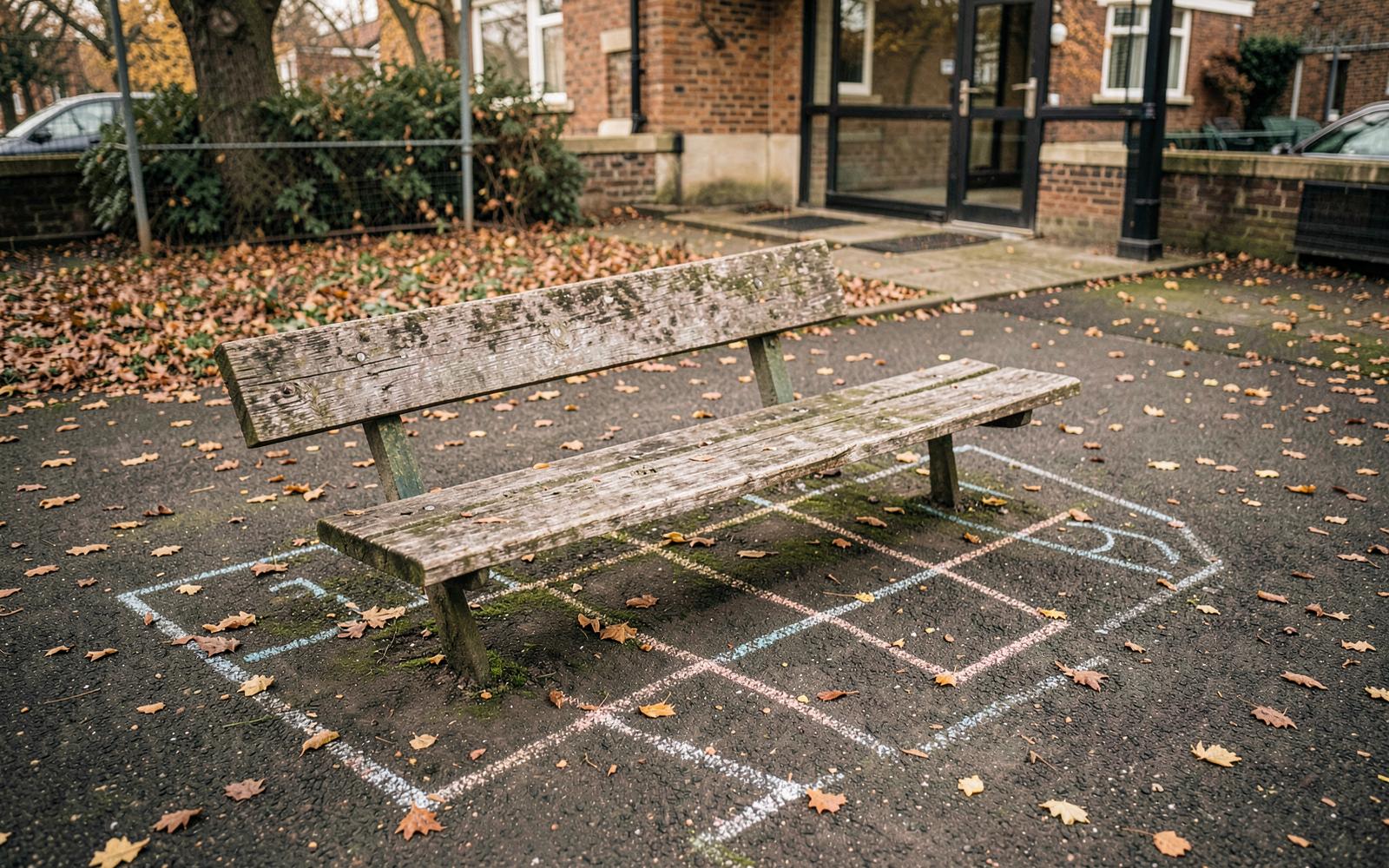
An empty wooden bench beside a primary school playground with a faded chalk hopscotch grid and autumn leaves.
MoreFor teachers

Belonging is built in the ordinary parts of the day

NICE and the DfE/PHE whole-school framework both put climate and relationships at the foundation of wellbeing provision. In practice that is not a scheme of work: it is who gets greeted, who gets asked, who is given a job, whose name you use, and who is picked last.

  • Greet every child at the door, by name, every day.
  • Know one non-school thing about each of them by half term.
  • Distribute jobs and responsibilities deliberately, not to the reliable few.
  • Choose the pairs and groups yourself when it matters — free choice reliably leaves the same children out.
  • Notice and name effort, kindness and repair as much as achievement.
  • Make sure every child gets a positive interaction with you in a week, and check who you missed.
The quick audit

List your class from memory. The ones you write last are usually the ones with the least connection — and they are rarely the ones causing trouble.

MoreFor teachers

Playtimes, lunchtimes and the seams

Most social difficulty happens where adults are fewest: the playground, the lunch hall, the queue, the corridor, wet play, changing for PE. These are also the least planned parts of the day and the least resourced in terms of trained adults.

Watch a playtime deliberately

Not on duty — observing. Fifteen minutes tells you more about a child's social position than a term of classroom observation.

Give a role, not a rescue

A job, a piece of equipment to look after, a game to run. It creates a reason to be with others without making the child a project.

Structured options

A lunchtime club, a board game table, a designated activity zone. Unstructured time is hardest for the children who most need somewhere to be.

Brief the lunchtime team

They see the most and are usually told the least. A two-minute handover about which children to keep an eye on is high value.

Plan wet play properly

It generates a disproportionate share of fallings-out. Defined activities and defined groupings help.

MoreFor teachers

Children who find this harder

Some children need more deliberate support to belong: those with speech, language and communication needs who cannot keep up with fast playground talk; autistic children whose social approach differs from the group's expectations; children with attention differences who are enthusiastic but overwhelming; children who have moved school, are new to English, or are in care.

The EEF's SEND guidance warns against arrangements that routinely separate pupils with SEND from their peers. Support that always removes a child from the group to work with an adult reduces the very contact that friendship depends on.

Do not appoint a helper

Assigning a kind child to look after another creates a caring relationship, not a friendship, and both children usually know it. Build shared activity instead — a genuine joint task with a genuine reason.

MoreFor teachers

Teaching the skills

Relationships education is statutory in primary schools in England, covering friendship, respect, boundaries and where to get help. EEF SEL guidance suggests teaching these skills explicitly and then reinforcing them in the ordinary running of the day — the reinforcement matters more than the lesson.

  • Teach joining in, asking, disagreeing, apologising and leaving a game as specific, practisable skills.
  • Use stories and class discussion to name what it feels like to be left out.
  • Model repair yourself when you get something wrong with a child.
  • Set out explicitly what to do if you see someone alone, and what to do if you see unkindness.
  • Revisit after holidays and at the start of a new year group, when social structures reset.
Practical ideasFor teachers

Things to avoid

  • Public picking of teams or partners.
  • Making a child's isolation visible by discussing it in front of others.
  • Forcing an apology that means nothing, instead of a repair that does.
  • Treating every dispute as bullying, or dismissing repeated targeting as a fall-out.
  • Leaving playtime social difficulty as pastoral background noise rather than something to plan for.
  • Assuming the quiet, contained child is fine.
ResearchFor teachers

Evidence & sources

What this guide is, and is not

Belonging is hard to measure and the evidence is largely about the conditions that support it rather than programmes that produce it. Nothing here diagnoses a social difficulty, and a child who prefers their own company is not automatically a child with a problem. The aim is that every child has someone who knows them and somewhere they are wanted — not that every child is sociable.

  1. National Institute for Health and Care ExcellenceProfessional guidance
    Social, emotional and mental wellbeing in primary and secondary education (NG223) (2022)

    Recommends a whole-school approach in which a supportive climate and trusted relationships between pupils and staff are foundational rather than additional.

  2. Public Health England / Department for EducationProfessional guidance
    Promoting children and young people's mental health and wellbeing: a whole-school and whole-college approach (2021)

    The eight-principle framework. Ethos and environment, and pupil voice, are two of the eight — belonging is treated as a structural property of the school, not a feeling to be encouraged.

  3. Education Endowment FoundationResearch summary
    Improving Social and Emotional Learning in Primary Schools — guidance report (2019, updated 2021)

    Teaching relationship skills explicitly and reinforcing them across the school day. Rated moderate impact, very low cost, moderate evidence.

  4. Education Endowment FoundationResearch summary
    Special Educational Needs in Mainstream Schools — guidance report (2020, updated 2021)

    Argues for building positive relationships and high-quality teaching as the first response, and warns against arrangements that separate pupils with SEND from their peers by default.

  5. Education Endowment FoundationResearch summary
    Mentoring — Teaching and Learning Toolkit

    A useful corrective: relationship-based approaches are valuable but the measured academic impact of mentoring programmes is low. Belonging matters in its own right, not as an attainment lever.

  6. Department for EducationProfessional guidance
    Preventing and tackling bullying (2017)

    Sets out schools' duties and the expectation that prevention rests on school ethos, not only on responding to incidents.

  7. Department for EducationStatutory guidance
    Relationships education, relationships and sex education (RSE) and health education (2019)

    Relationships education is statutory in all primary schools in England — friendship, respect, boundaries and loneliness are curriculum content, not optional extras.

  8. Department for EducationStatutory guidance
    SEND Code of Practice: 0 to 25 years (2015)

    Sets expectations for participation and inclusion, and for involving children and families in decisions about them.

  9. Department for EducationStatutory guidance
    Working together to improve school attendance (2022, statutory from 2024)

    Places belonging and relationships explicitly within attendance work — children attend places where they feel known and safe.

  10. Anna FreudProfessional guidance
    Resources for schools and colleges

    UK mental health charity material on relational practice, belonging and whole-school culture in primary settings.

  11. Anna FreudProfessional guidance
    Mentally Healthy Schools

    Quality-assured primary-focused resources on friendship, connection and inclusion.

Supporting Families
Looking for a parent-friendly version of Relationships & Belonging?

The Kind Learner Space has this guide in plain English for families — the same evidence, translated for home.

Open in The Kind Learner Space
Continue exploring

Where to go next.

A calm handful of next steps — not a checklist. Follow whichever thread is most useful right now.

Related guides

A natural next thread.

For families

Share this at home.

A plain-English version parents and carers can read at home — same evidence, warmer language.

Same category

More in Social, Emotional & Mental Health.

Emotional wellbeing, relationships, regulation, anxiety, trauma and belonging.

You may also find these helpful

Related Evidence Guides

Each guide below connects to the one you've just read. We've noted why — so you can follow the thread that matters most to you.

A stack of well-loved picture books beside a notebook on a wooden desk in soft window light.
Evidence guide · 12 min read

Working Memory

The mental notepad that lets a child hold information in mind long enough to use it — and the small changes that make the biggest difference.

Explore
A pegboard on a classroom wall with wooden name tags in warm afternoon light.
Evidence guide · 14 min read

Executive Function

Planning, flexibility and impulse control — the mental machinery that lets a developing brain get things done.

Explore
An open book and pencil on a classroom desk lit by low morning sunlight through a window.
Evidence guide · 11 min read

Attention

What we mean by attention, why it wanders, and the classroom conditions that help it hold.

Explore
A quiet primary classroom corner with soft natural light, uncluttered surfaces and calm materials.
Evidence guide · 11 min read

Cognitive Load

How lesson design shapes what a working memory can carry — and the small design choices that free up thinking for learning.

Explore
A child's small hands holding an autumn maple leaf in soft window light.
Evidence guide · 10 min read

Processing Speed

The pace at which a child takes in, makes sense of and responds to information — and why slower doesn't mean less capable.

Explore
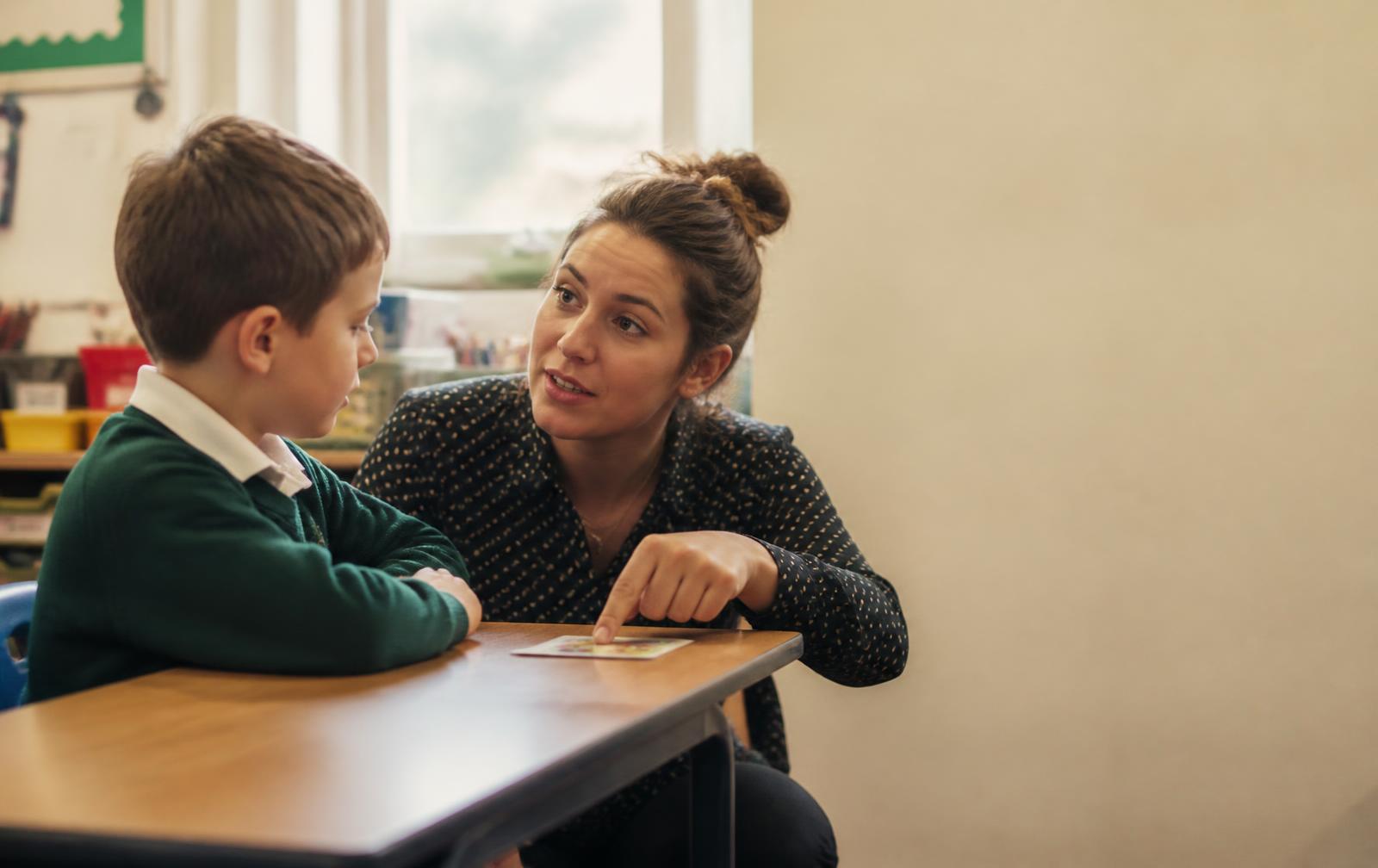
A teacher crouched at eye level beside a young child at a classroom desk, pointing at a small visual card in soft window light.
Evidence guide · 13 min read

Understanding Spoken Language

How children make sense of what adults say — and what we can change about the way we communicate so that more children understand, participate and show what they know.

Explore
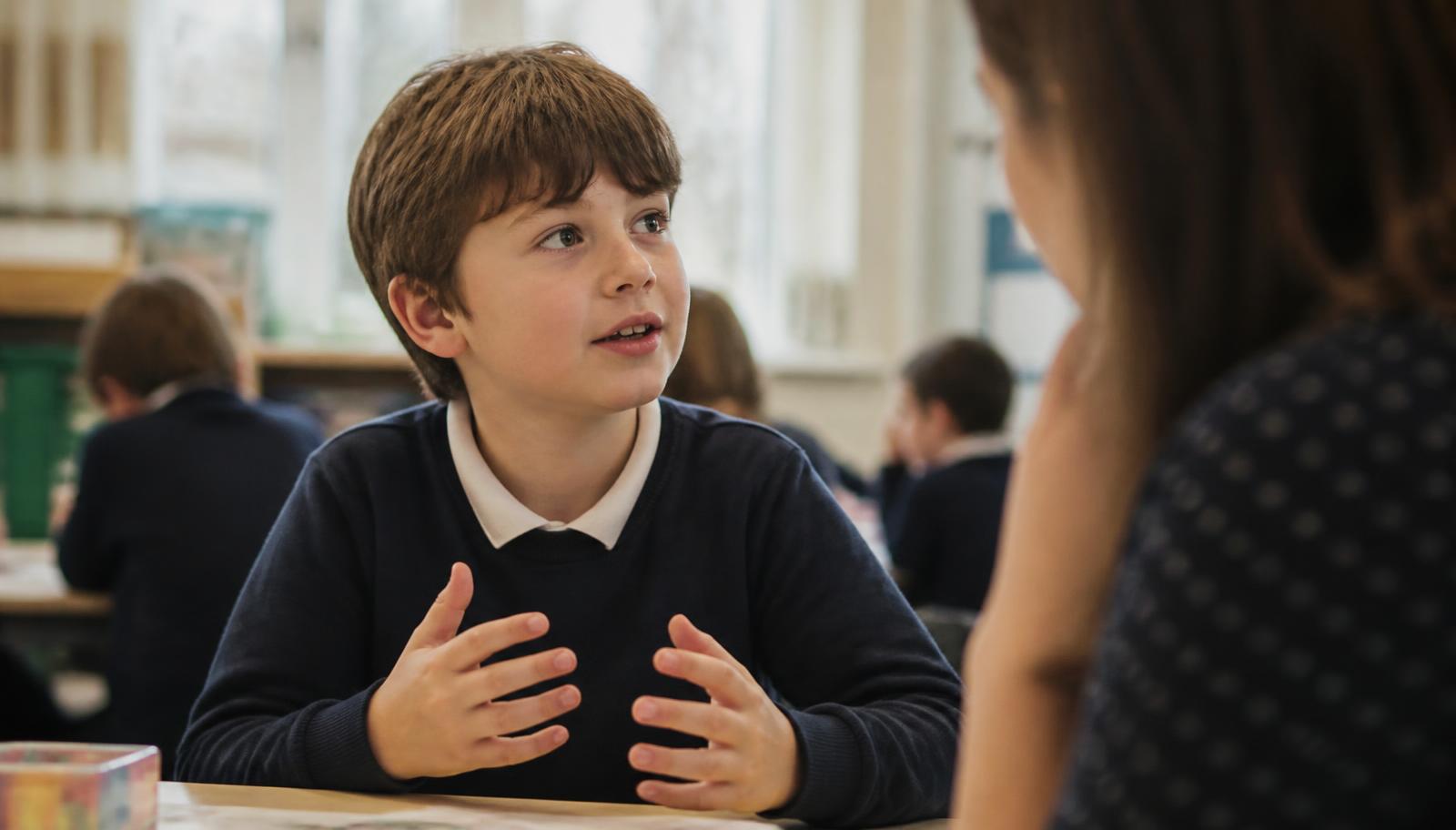
A young primary school child talking animatedly to an adult across a classroom table in soft window light.
Evidence guide · 14 min read

Expressive Language

Why this is relevant

Playground talk is fast and unforgiving; language difficulty is often behind social difficulty.

Explore
An adult and a young primary school child sitting side by side over an open picture book in soft window light.
Evidence guide · 14 min read

Vocabulary & Word Knowledge

What it means to really know a word, why word knowledge sits underneath so much classroom learning, and how adults can build it deliberately without turning language into a deficit.

Explore
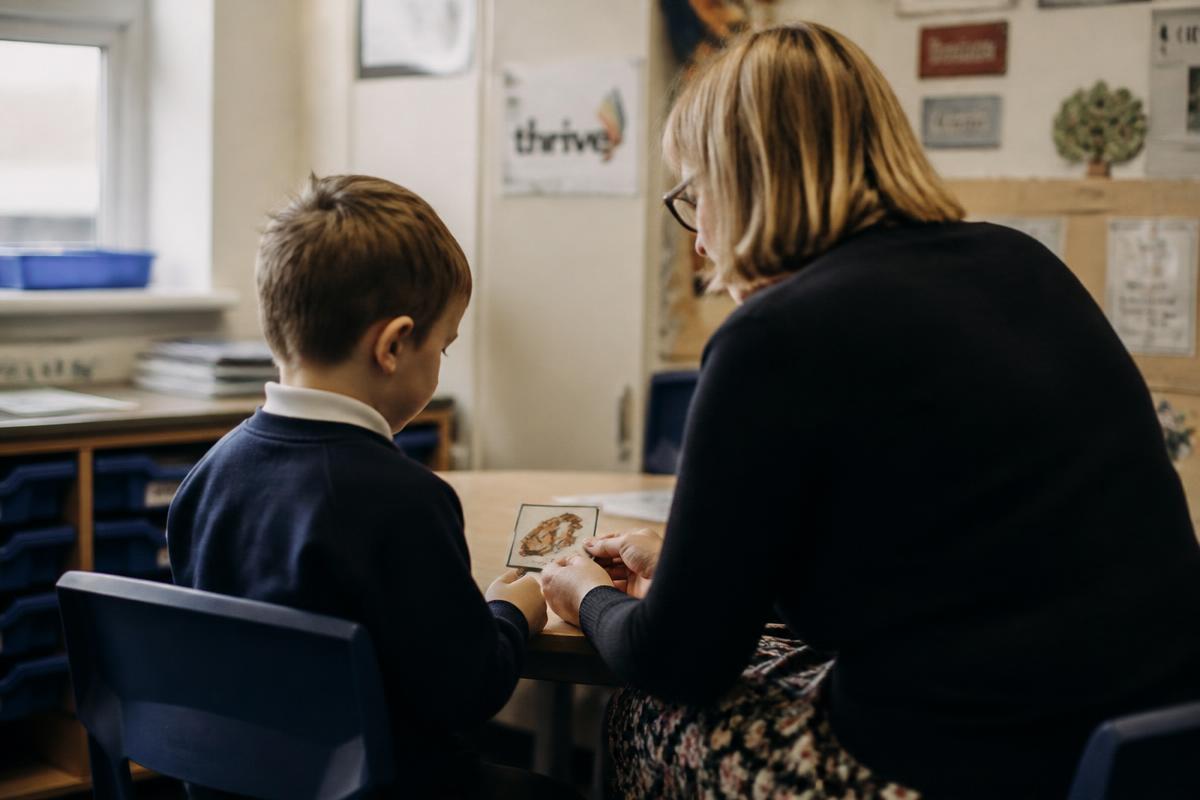
An adult and a young primary school child sitting side by side at a classroom table, looking together at a small picture card in soft window light.
Evidence guide · 14 min read

Speech Sounds & Speech Clarity

Being hard to understand is not the same as having less to say. What speech sounds are, how clarity develops at different rates, and how to keep a child fully included while it does.

Explore
A quiet primary school book corner with a wooden bench, cushions and a basket of picture books beside a window in soft daylight.
Evidence guide · 15 min read

Emotional Regulation

Why this is relevant

Regulation is learned through relationship; a trusted adult is the mechanism, not the reward.

Explore
A quiet primary school cloakroom with a single coat and book bag on a wooden peg rail in soft morning light.
Evidence guide · 15 min read

Anxiety & Worry

Why this is relevant

Loneliness and social worry are among the most common reasons school starts to feel unsafe.

Explore
A quiet primary classroom carpet area with cushions and a low bookshelf in soft daylight.
Evidence guide · 16 min read

Understanding Behaviour

Why this is relevant

Belonging changes behaviour more reliably than most behaviour systems do.

Explore
An empty primary school desk with a pencil pot and notebook beside a wooden chair with a wobble cushion, in soft morning light.
Evidence guide · 16 min read

ADHD

Attention, impulse and activity are shaped as much by the situation as by the child. This guide looks at what ADHD is, what it is not, and what actually helps in a mainstream primary classroom and at home.

Explore
A quiet corner of a primary classroom with a low wooden shelf of neatly arranged wooden blocks and a folded blanket beside a window.
Evidence guide · 17 min read

Autism

Autism is a difference in how a person communicates, experiences the world and makes sense of it — not a list of deficits. This guide looks at what may be relevant, what the environment contributes, and what genuinely helps in a mainstream primary school.

Explore
An open book resting on a wooden primary school table beside a pencil and reading glasses in soft window light.
Evidence guide · 16 min read

Dyslexia

Dyslexia is about accurate, fluent word reading and spelling — not reversed letters or a visual learning style. This guide separates what is known from what is myth, and sets out the teaching and adjustments that actually help.

Explore
An adult's hand gently holding a young child's hand in soft natural light.
Evidence guide · 13 min read

School Attendance

When getting to school becomes the hardest part of the day. What can sit underneath attendance difficulties, how families and schools can work on it together, and what the guidance actually expects.

Explore
A calm, quiet reading corner in a primary classroom with cushions and soft daylight.
Evidence guide · 11 min read

Transitions

Moving from one thing to the next — between activities, places, people and years. Why change can be so hard for some children, and the calm, predictable preparation that helps.

Explore
Soft natural textures and calm materials arranged in gentle daylight.
Evidence guide · 11 min read

Sensory Needs

Some children experience noise, light, touch, smell or movement more — or less — intensely than others. What that can look like, why it matters for learning and wellbeing, and the calm adjustments that help.

Explore
A tidy wooden desk with a notebook and pencils in soft window light.
Evidence guide · 9 min read

Homework

Making home learning calmer for everyone. What the evidence says about primary homework, why it can be so hard after a long school day, and how families and schools can keep it purposeful rather than painful.

Explore
A parent and child sharing a picture book together in soft, warm light.
Evidence guide · 9 min read

Sleep

Small, steady changes that help a child settle and stay asleep — and why sleep matters so much for learning, mood and coping. Based on NHS advice.

Explore