Evidence Guide
14 min read

Vocabulary & Word Knowledge

What it means to really know a word, why word knowledge sits underneath so much classroom learning, and how adults can build it deliberately without turning language into a deficit.

Reading time
14 min read
Age range
All primary (EYFS–KS2)
Evidence level
High
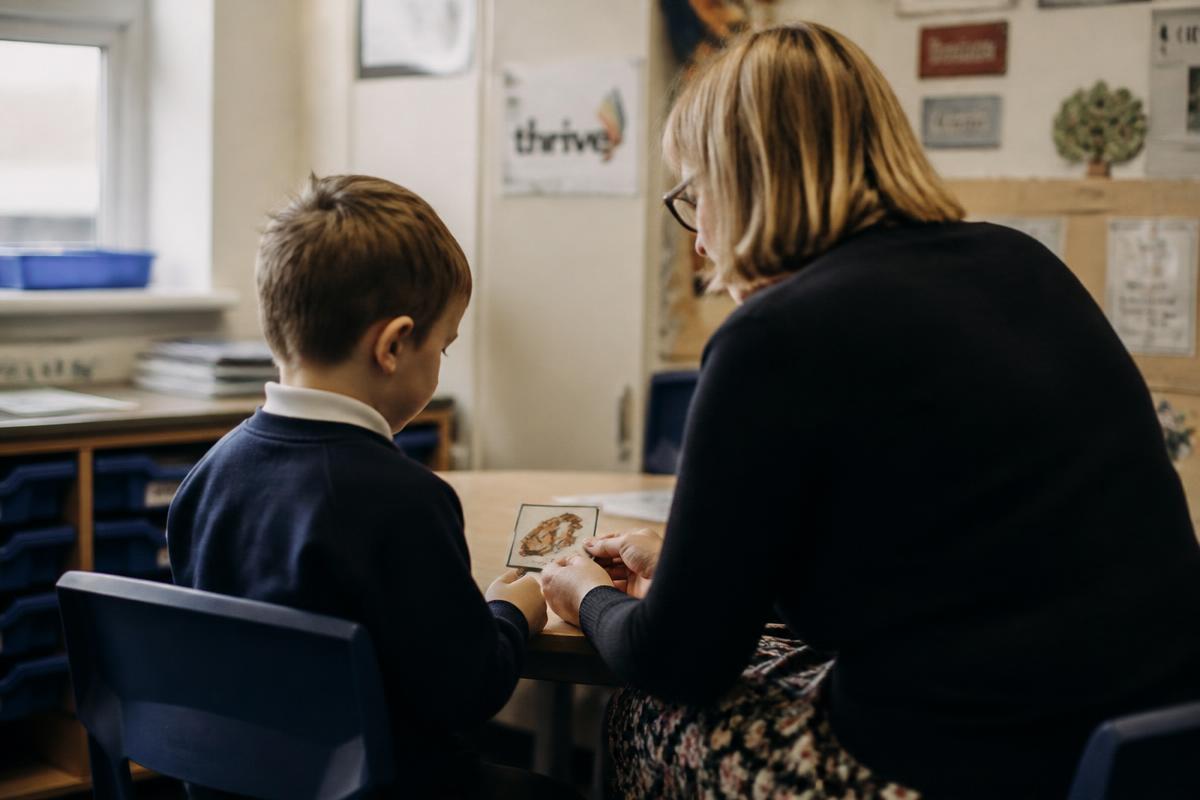
An adult and a young primary school child sitting side by side over an open picture book in soft window light.
Leader guidanceFor leaders

Whole-school implications

The DfE's reading framework makes language comprehension one of two components of reading. That places vocabulary in every subject, not in the English lead's folder — and it means a school can have strong phonics outcomes and weak comprehension outcomes at the same time.

  • Specify the vocabulary each subject and year group is responsible for teaching, and where it is revisited.
  • Expect the same core practices — explicit teaching of a small word set, structured talk, daily reading aloud — in every classroom.
  • Check that assessment separates what a pupil knows from the vocabulary the question happened to use.
  • Make sure pupils learning EAL are visible as a distinct group in your analysis, and not counted as SEND by default.
Leader guidanceFor leaders

Staff development

Train on selection, not on displays

Choosing the right two or three words for a unit is the skill that changes outcomes. It is also the part most often skipped in favour of resources.

Use the EEF guidance reports as the shared reference

Preparing for Literacy, Improving Literacy in KS1 and KS2 give a common, credible and free basis for what the school expects.

Include support staff from the start

Teaching assistants deliver much of the pre-teaching in most primary schools and are frequently trained last.

Correct the word-gap narrative internally

The 30-million-word figure still circulates in training materials despite failing to replicate. Retiring it protects both accuracy and your relationship with families.

Coach in classrooms

Modelling a three-minute pre-teach in someone's lesson shifts practice more reliably than a slide deck. Protect the time.

Leader guidanceFor leaders

Curriculum and environment

  • Map subject vocabulary vertically so that Year 5 builds on Year 3 rather than restarting.
  • Protect a daily read-aloud in every year group, including Year 6. It is the cheapest vocabulary provision available.
  • Audit the library and reading spine for range as well as quality — narrow reading gives narrow vocabulary.
  • Build in structured, purposeful talk rather than hoping discussion happens.
  • Ensure home languages are visible and valued in the environment; the evidence does not support suppressing them.
MoreFor leaders

Strategic leadership and value for money

  • Before funding a vocabulary programme, ask what it adds beyond explicit teaching and revisiting in existing lessons.
  • Treat EEF Toolkit ratings as averages across studies, not as guarantees for your cohort.
  • Track comprehension and vocabulary outcomes for disadvantaged pupils and pupils learning EAL separately — they are different groups with different needs.
  • Give the SENDCO protected time; the SEND Code of Practice frames the role as strategic.
  • Work with feeder early years settings, where communication and language is a prime area of the EYFS and transition information is often lost.
ResearchFor leaders

Evidence and sources

How to read the evidence

Some of what follows is statutory guidance schools must follow, some is a synthesis of research, and some is widely recommended practice that has not been separately trialled. We have tried to say which is which. The EEF rates oral language approaches — explicit vocabulary teaching among them — as high impact for very low cost on extensive evidence, but it has not published separate effect sizes for individual techniques such as word walls or knowledge organisers. And an average effect across many studies is not a promise about any one child.

About the "word gap"

You will meet the claim that children from poorer homes hear 30 million fewer words. It comes from a small American study from 1995, and a 2019 replication attempt in Child Development did not reproduce it. Vocabulary at school entry does vary, and that variation does predict later attainment — but the causes are complex, and framing it as a family failing is both unkind and unsupported. Teach vocabulary because it is teachable, not because anyone is deficient.

  1. Department for EducationProfessional guidance
    The reading framework: teaching the foundations of literacy (2021, updated 2023)

    Sets out the Simple View of Reading — comprehension depends on word reading and language comprehension together — and a substantial section on developing talk. It is about teaching practice, not about any particular vocabulary programme.

  2. Department for EducationStatutory guidance
    SEND Code of Practice: 0 to 25 years (2015)

    Names communication and interaction as one of the four broad areas of SEN and sets out the graduated approach — assess, plan, do, review — that schools must follow.

  3. Department for EducationStatutory guidance
    Early years foundation stage statutory framework (current version)

    Communication and language is one of three prime areas; providers must give children a language-rich environment and back-and-forth conversation.

  4. Education Endowment FoundationResearch summary
    Oral language interventions (Teaching and Learning Toolkit)

    Rates oral language approaches — including explicit vocabulary teaching and structured discussion — as high impact for very low cost, based on extensive evidence. The Toolkit is revised periodically; check the live page for the current figure rather than quoting an older one.

  5. Education Endowment FoundationResearch summary
    Preparing for Literacy: improving communication, language and literacy in the early years (2018)

    Recommends high-quality adult–child interaction and deliberate vocabulary development, and notes the recommendations may also apply to older pupils who have fallen behind.

  6. Education Endowment FoundationResearch summary
    Improving Literacy in Key Stage 1 (2017, updated)

    Places language capability — vocabulary, listening and structured talk — among the foundations of early reading and writing.

  7. Education Endowment FoundationResearch summary
    Improving Literacy in Key Stage 2 (2017, updated 2021)

    Recommends teaching a small number of useful words in depth, teaching pupils how words work — including roots, prefixes and suffixes — and using structured discussion to build comprehension.

  8. Education Endowment FoundationResearch summary
    Getting to the root of vocabulary instruction (blog) (2024)

    Discusses morphology — teaching how words are built — as a promising approach. Promising is the right word: the UK trial base here is still small.

  9. Royal College of Speech and Language TherapistsProfessional guidance
    Clinical information: developmental language disorder (DLD)

    Reports that DLD affects around 7.6% of children — roughly two in a class of thirty. DLD affects understanding and using language and is diagnosed by a speech and language therapist, not inferred from a low vocabulary score.

  10. NICEProfessional guidance
    Early years: promoting health and wellbeing in under 5s (QS128), quality statement 2: speech and language (2016)

    Notes that children with communication difficulties are at increased risk of social, emotional and behavioural difficulties. It concerns early identification in the under-fives, not primary-age vocabulary teaching.

  11. Clegg, Law, Rush, Peters & RoulstoneResearch evidence
    The contribution of early language development to children's emotional and behavioural functioning at 6 years (ALSPAC), Journal of Child Psychology and Psychiatry (2015)

    UK birth-cohort study finding an association between early language and later emotional and behavioural functioning. Observational, so it shows a link, not that improving vocabulary improves behaviour.

  12. Dixon, Thomson & FrickeResearch evidence
    Evaluation of an explicit vocabulary teaching intervention for children learning English as an additional language in primary school, Child Language Teaching and Therapy (2020)

    UK primary evaluation showing explicit vocabulary teaching benefits pupils learning English as an additional language.

  13. Murphy & Unthiah (University of Oxford, for the EEF and the Bell Foundation)Research summary
    A systematic review of intervention research examining English language and literacy development in children with EAL (2015)

    Review of what helps pupils learning EAL. A lower score on an English-only vocabulary test is a measure of English exposure, not of ability or of a language disorder.

  14. CushingResearch evidence
    Word rich or word poor? Deficit discourses, raciolinguistic ideologies and the resurgence of the 'word gap' in England's education policy, Critical Inquiry in Language Studies (2022)

    A UK critique of how the 'word gap' has been used in English education policy. Worth reading alongside the vocabulary literature, not instead of it.

  15. Sperry, Sperry & MillerResearch evidence
    Reexamining the verbal environments of children from different socioeconomic backgrounds, Child Development (2019)

    Found that the widely quoted '30 million word gap' figure (Hart & Risley, 1995, USA) does not replicate. The figure is still repeated in training materials; it should not be treated as established fact.

  16. Speech and Language UKProfessional guidance
    Ages and Stages

    Qualitative descriptions of typical communication development by age band. Ranges, not norms — individual variation is expected.

  17. NHSProfessional guidance
    Help your child learn to talk

    Plain-language NHS advice for families on everyday talk. Practical guidance rather than a research source.


Supporting Families
Looking for a parent-friendly version of Vocabulary & Word Knowledge?

The Kind Learner Space has this guide in plain English for families — the same evidence, translated for home.

Open in The Kind Learner Space
Continue exploring

Where to go next.

A calm handful of next steps — not a checklist. Follow whichever thread is most useful right now.

For families

Share this at home.

A plain-English version parents and carers can read at home — same evidence, warmer language.

Browse by theme

Zoom out.

Sensory, attention, communication, wellbeing — see how this topic sits alongside the wider picture.

Learning pathway

Take the longer route.

Working memory, attention, executive function and cognitive load — threaded into one guided journey.

You may also find these helpful

Related Evidence Guides

Each guide below connects to the one you've just read. We've noted why — so you can follow the thread that matters most to you.

A stack of well-loved picture books beside a notebook on a wooden desk in soft window light.
Evidence guide · 12 min read

Working Memory

Why this is relevant

New words have to be held in mind long enough to be linked to meaning — which is why repeated, spaced encounters work better than long lists.

Explore
A pegboard on a classroom wall with wooden name tags in warm afternoon light.
Evidence guide · 14 min read

Executive Function

Why this is relevant

Choosing the precise word while planning a sentence is an executive task as much as a vocabulary one.

Explore
An open book and pencil on a classroom desk lit by low morning sunlight through a window.
Evidence guide · 11 min read

Attention

Why this is relevant

A word can only be learned if it was noticed; attention determines which of the day's words a child actually meets.

Explore
A quiet primary classroom corner with soft natural light, uncluttered surfaces and calm materials.
Evidence guide · 11 min read

Cognitive Load

Why this is relevant

Unfamiliar vocabulary is extraneous load — every unknown word in a task takes capacity away from the thinking it was set for.

Explore
A child's small hands holding an autumn maple leaf in soft window light.
Evidence guide · 10 min read

Processing Speed

Why this is relevant

Retrieving a word takes time; slower processing makes word-finding look like not knowing.

Explore
A teacher crouched at eye level beside a young child at a classroom desk, pointing at a small visual card in soft window light.
Evidence guide · 13 min read

Understanding Spoken Language

Why this is relevant

Word knowledge is one part of understanding — this guide covers the processing, memory and language demands around it.

Explore
A young primary school child talking animatedly to an adult across a classroom table in soft window light.
Evidence guide · 14 min read

Expressive Language

Why this is relevant

How children get words out: word-finding, sentence building and sequencing, which vocabulary alone does not explain.

Explore
An adult and a young primary school child sitting side by side at a classroom table, looking together at a small picture card in soft window light.
Evidence guide · 14 min read

Speech Sounds & Speech Clarity

Why this is relevant

When speech is hard to understand, vocabulary can be underestimated — this guide explains how to tell them apart.

Explore
A quiet primary school book corner with a wooden bench, cushions and a basket of picture books beside a window in soft daylight.
Evidence guide · 15 min read

Emotional Regulation

Not the ability to stay calm. What emotional regulation actually involves, how it grows through relationships, and what genuinely helps at home and in class — with the strength of the evidence stated plainly.

Explore