
Evidence Guide
12 min read

Working Memory

The mental notepad that lets a child hold information in mind long enough to use it — and the small changes that make the biggest difference.

Reading time
12 min read
Age range
All primary (EYFS–KS2)
Evidence level
High
A stack of well-loved picture books beside a notebook on a wooden desk in soft window light.
AssessmentFor SENDCOs

Assessment considerations

  • Triangulate: classroom observation, teacher notes, work sampling — not standardised memory tests alone.
  • Look for patterns across contexts: does it show in maths but not reading? In afternoon lessons only?
  • Rule out obvious contributors: sleep, hearing, anxiety, unfamiliar routines.
  • Consider co-occurring profiles (dyslexia, ADHD, DLD) — working memory is often part of a wider picture.

ProvisionFor SENDCOs

Provision planning

Universal first

Ensure quality-first teaching adaptations are in place across every class before layering intervention.

Targeted

Pre-teach vocabulary and concepts, provide visual scaffolds, use precision teaching for specific skills.

Specialist

Where universal and targeted don't shift the picture, seek specialist assessment through the EP or SALT service.

Supporting Families
Looking for a parent-friendly version of Working Memory?

The Kind Learner Space has this guide in plain English for families — the same evidence, translated for home.

Open in The Kind Learner Space
Continue exploring

Where to go next.

A calm handful of next steps — not a checklist. Follow whichever thread is most useful right now.

For families

Share this at home.

A plain-English version parents and carers can read at home — same evidence, warmer language.

Browse by theme

Zoom out.

Sensory, attention, communication, wellbeing — see how this topic sits alongside the wider picture.

Learning pathway

Take the longer route.

Working memory, attention, executive function and cognitive load — threaded into one guided journey.

You may also find these helpful

Related Evidence Guides

Each guide below connects to the one you've just read. We've noted why — so you can follow the thread that matters most to you.

A pegboard on a classroom wall with wooden name tags in warm afternoon light.
Evidence guide · 14 min read

Executive Function

Why this is relevant

Executive function orchestrates working memory — planning, holding a goal in mind and switching between steps all draw from it.

Explore
An open book and pencil on a classroom desk lit by low morning sunlight through a window.
Evidence guide · 11 min read

Attention

Why this is relevant

Attention and working memory work in tandem — a child cannot hold what they never fully attended to.

Explore
A quiet primary classroom corner with soft natural light, uncluttered surfaces and calm materials.
Evidence guide · 11 min read

Cognitive Load

Why this is relevant

Explains how lesson design affects the demands placed on working memory — reduce the load and more capacity is freed for learning.

Explore
A child's small hands holding an autumn maple leaf in soft window light.
Evidence guide · 10 min read

Processing Speed

Why this is relevant

Slower processing keeps information in working memory longer, increasing the chance it fades before it can be used.

Explore
A teacher crouched at eye level beside a young child at a classroom desk, pointing at a small visual card in soft window light.
Evidence guide · 13 min read

Understanding Spoken Language

How children make sense of what adults say — and what we can change about the way we communicate so that more children understand, participate and show what they know.

Explore
A young primary school child talking animatedly to an adult across a classroom table in soft window light.
Evidence guide · 14 min read

Expressive Language

How children put their thoughts, ideas, needs and experiences into words — and what adults can change so that more children can show what they think and know.

Explore
An adult and a young primary school child sitting side by side over an open picture book in soft window light.
Evidence guide · 14 min read

Vocabulary & Word Knowledge

What it means to really know a word, why word knowledge sits underneath so much classroom learning, and how adults can build it deliberately without turning language into a deficit.

Explore
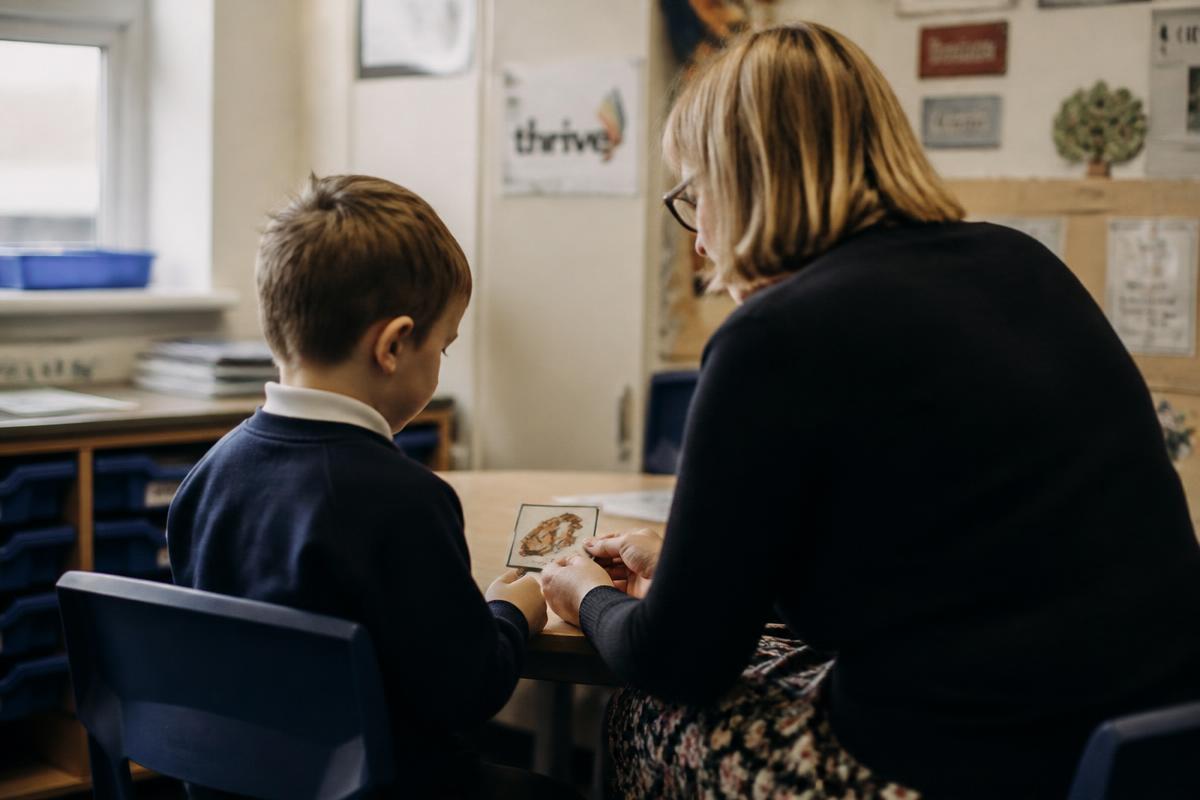
An adult and a young primary school child sitting side by side at a classroom table, looking together at a small picture card in soft window light.
Evidence guide · 14 min read

Speech Sounds & Speech Clarity

Being hard to understand is not the same as having less to say. What speech sounds are, how clarity develops at different rates, and how to keep a child fully included while it does.

Explore
A quiet primary school book corner with a wooden bench, cushions and a basket of picture books beside a window in soft daylight.
Evidence guide · 15 min read

Emotional Regulation

Not the ability to stay calm. What emotional regulation actually involves, how it grows through relationships, and what genuinely helps at home and in class — with the strength of the evidence stated plainly.

Explore