Skip to content
Evidence Guide
16 min read

Dyslexia

Dyslexia is about accurate, fluent word reading and spelling — not reversed letters or a visual learning style. This guide separates what is known from what is myth, and sets out the teaching and adjustments that actually help.

Reading time
16 min read
Age range
All primary (EYFS–KS2)
Evidence level
High
An open book resting on a wooden primary school table beside a pencil and reading glasses in soft window light.
Leader guidanceFor leaders

This is a curriculum issue before it is a SEND issue

The strongest protection a school can offer children with dyslexia is excellent, consistent literacy teaching for everyone, with rapid, structured catch-up for those who fall behind. The EEF's literacy guidance reports and its rating of phonics as high impact for very low cost make that a leadership priority rather than an intervention question.

The 2026 Neurodivergence Task and Finish Group report — recommendations to DfE, not statutory requirements — argues for earlier identification of strengths and needs in the setting and for stronger workforce knowledge. For literacy, that translates straightforwardly into assessment that catches children early and staff who know what to do about it.

MoreFor leaders

Staff knowledge and development

Teach the model of reading

Staff who understand decoding, fluency, language comprehension and their interaction can diagnose in the moment. Staff who only know programmes cannot.

Include Key Stage 2 and subject teaching

Reading difficulty does not end at Year 2, and the curriculum becomes more text-dependent exactly as support often thins out.

Train those delivering intervention properly

Fidelity and skill matter more than which programme is purchased. Untrained delivery is one of the commonest reasons intervention shows no impact.

Correct the myths in training

Letter reversal, visual learning styles, overlays, fonts. Staff repeat these in good faith and families act on them.

Make adjustment a whole-staff expectation

Every teacher, every subject, every supply cover — not an English department matter.

AssessmentFor leaders

Systems, assessment and resourcing

  • Early screening and regular fluency checks, with a clear threshold that triggers action rather than monitoring.
  • Timetabled intervention slots that do not remove children from the teaching they most need.
  • Books matched to phonic knowledge, in sufficient quantity, and age-respectful for older pupils.
  • Assistive technology available, maintained, and taught — not stored in a cupboard.
  • Marking and homework policies that do not penalise transcription when the objective is something else.
  • Access arrangements aligned with normal classroom practice.
  • Information transfer at transition that names what works, not just the diagnosis.
ProvisionFor leaders

Evaluating whether provision is working

  • Component skill data — decoding, fluency, spelling — not reading ages alone.
  • Progress of the lowest 20% of readers as a specific, reported measure.
  • Attainment across the wider curriculum for pupils with literacy difficulties, which shows whether adjustments are real.
  • Participation: are these pupils reading in class, contributing, taking part in the same curriculum?
  • Wellbeing and self-concept, gathered through pupil voice.
  • Intervention impact evaluated per programme, with the willingness to stop what is not working.
  • Parent experience, including whether they understand what is in place and why.
The measure that matters

Not how many children are on an intervention, but whether the children who could not read a year ago can read now — and whether the ones who still cannot are nonetheless learning the rest of the curriculum.

MoreFor leaders

Policy context, stated carefully

  • Current statutory guidance: SEND Code of Practice (2015), where dyslexia sits within cognition and learning; the Equality Act duty to make reasonable adjustments.
  • Current professional guidance: the Rose report (2009) remains the reference point for identification and teaching in England; NHS information for families.
  • Evidence reviews: EEF literacy guidance reports and Toolkit strands; the DfE-commissioned UCL rapid evidence review on cognition and learning (2025), which is explicitly not government policy.
  • Recommendations: the independent Neurodivergence Task and Finish Group report (February 2026).
  • Proposed reform: ongoing SEND reform. Do not present proposals as current requirements to staff or families.
ResearchFor leaders

Evidence & sources

The teaching does not wait for the label

A child who is struggling to read needs high-quality, structured teaching now. That is true before assessment, during a wait, if the assessment concludes dyslexia, and if it does not. The value of an assessment is a clearer profile and, sometimes, access to arrangements and services — not permission to start teaching properly.

What this guide is, and is not

This is an educational resource. It does not identify or diagnose dyslexia; formal assessment is usually carried out by an educational psychologist or a specialist assessor with an appropriate practising certificate. It is also worth saying plainly that the boundary between dyslexia and other reading difficulties is genuinely debated among researchers. What is not debated is what helps: the teaching is broadly the same whether or not a child has a label.

  1. NHSProfessional guidance
    Dyslexia in children

    Plain-English NHS information for families on what dyslexia is, what is commonly noticed, and where to go for help.

  2. Sir Jim Rose / Department for Children, Schools and FamiliesProfessional guidance
    Identifying and Teaching Children and Young People with Dyslexia and Literacy Difficulties (2009)

    The independent report that shaped English practice: dyslexia as difficulties in accurate and fluent word reading and spelling, best understood as a continuum rather than a category with a clear cut-off.

  3. British Psychological SocietyProfessional guidance
    Dyslexia, Literacy and Psychological Assessment (1999, updated 2005)

    The BPS working party report for educational psychologists. Important for why assessment should describe literacy difficulties and what to teach, rather than only award or withhold a label.

  4. Education Endowment FoundationResearch summary
    Improving Literacy in Key Stage 1 — guidance report (2017, updated 2020)

    Recommendations on developing language, phonological awareness, systematic phonics, fluency and targeted support for struggling readers.

  5. Education Endowment FoundationResearch summary
    Improving Literacy in Key Stage 2 — guidance report (2017, second edition 2021)

    Reading fluency, vocabulary, comprehension strategies, writing, and structured intervention for pupils who have fallen behind.

  6. Education Endowment FoundationResearch summary
    Phonics — Teaching and Learning Toolkit

    Rated high impact for very low cost, based on very extensive evidence, with the largest effects for pupils who are struggling with early reading.

  7. Education Endowment FoundationResearch summary
    Special Educational Needs in Mainstream Schools — guidance report (2020, updated 2021)

    High-quality teaching first, careful scaffolding, and cautious deployment of teaching assistants and technology.

  8. Department for Education / University College LondonResearch summary
    Identifying and supporting children and young people with cognition and learning needs: a rapid evidence review (September 2025)

    DfE-commissioned UCL review. Carries an explicit disclaimer that it is not an endorsement and does not reflect government policy.

  9. Department for EducationResearch summary
    Neurodivergence Task and Finish Group: report — recommendations for mainstream education (February 2026)

    Independent recommendations to DfE, including timely identification of strengths and needs in the setting rather than reliance on diagnostic queues.

  10. Department for EducationStatutory guidance
    SEND Code of Practice: 0 to 25 years (2015)

    Current statutory guidance. Specific learning difficulties, including dyslexia, sit within cognition and learning; provision follows identified need.

Supporting Families
Looking for a parent-friendly version of Dyslexia?

The Kind Learner Space has this guide in plain English for families — the same evidence, translated for home.

Open in The Kind Learner Space
Continue exploring

Where to go next.

A calm handful of next steps — not a checklist. Follow whichever thread is most useful right now.

For families

Share this at home.

A plain-English version parents and carers can read at home — same evidence, warmer language.

Same category

More in Neurodevelopment.

ADHD, Autism, Dyslexia, Dyspraxia, sensory processing and related neurodevelopmental profiles.

You may also find these helpful

Related Evidence Guides

Each guide below connects to the one you've just read. We've noted why — so you can follow the thread that matters most to you.

A stack of well-loved picture books beside a notebook on a wooden desk in soft window light.
Evidence guide · 12 min read

Working Memory

Why this is relevant

Holding sounds and words in mind while decoding draws on working memory for many children.

Explore
A pegboard on a classroom wall with wooden name tags in warm afternoon light.
Evidence guide · 14 min read

Executive Function

Planning, flexibility and impulse control — the mental machinery that lets a developing brain get things done.

Explore
An open book and pencil on a classroom desk lit by low morning sunlight through a window.
Evidence guide · 11 min read

Attention

What we mean by attention, why it wanders, and the classroom conditions that help it hold.

Explore
A quiet primary classroom corner with soft natural light, uncluttered surfaces and calm materials.
Evidence guide · 11 min read

Cognitive Load

Why this is relevant

Reducing what a task demands elsewhere frees capacity for the reading itself.

Explore
A child's small hands holding an autumn maple leaf in soft window light.
Evidence guide · 10 min read

Processing Speed

Why this is relevant

Reading fluency and processing speed interact — this guide covers pace without lowering expectation.

Explore
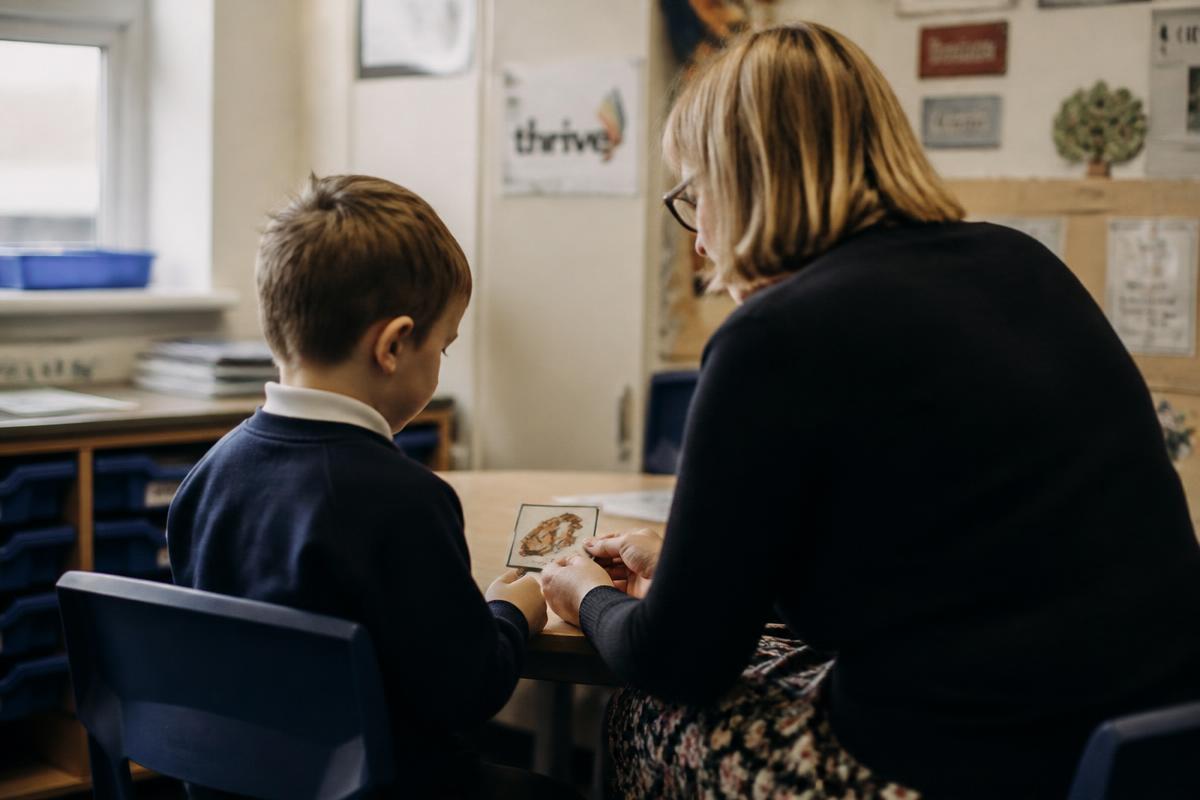
A teacher crouched at eye level beside a young child at a classroom desk, pointing at a small visual card in soft window light.
Evidence guide · 13 min read

Understanding Spoken Language

How children make sense of what adults say — and what we can change about the way we communicate so that more children understand, participate and show what they know.

Explore
A young primary school child talking animatedly to an adult across a classroom table in soft window light.
Evidence guide · 14 min read

Expressive Language

How children put their thoughts, ideas, needs and experiences into words — and what adults can change so that more children can show what they think and know.

Explore
An adult and a young primary school child sitting side by side over an open picture book in soft window light.
Evidence guide · 14 min read

Vocabulary & Word Knowledge

Why this is relevant

Comprehension depends on word knowledge, and children who read less get less of it incidentally.

Explore
An adult and a young primary school child sitting side by side at a classroom table, looking together at a small picture card in soft window light.
Evidence guide · 14 min read

Speech Sounds & Speech Clarity

Why this is relevant

Phonological awareness sits underneath both. Worth reading where early speech sounds were also difficult.

Explore
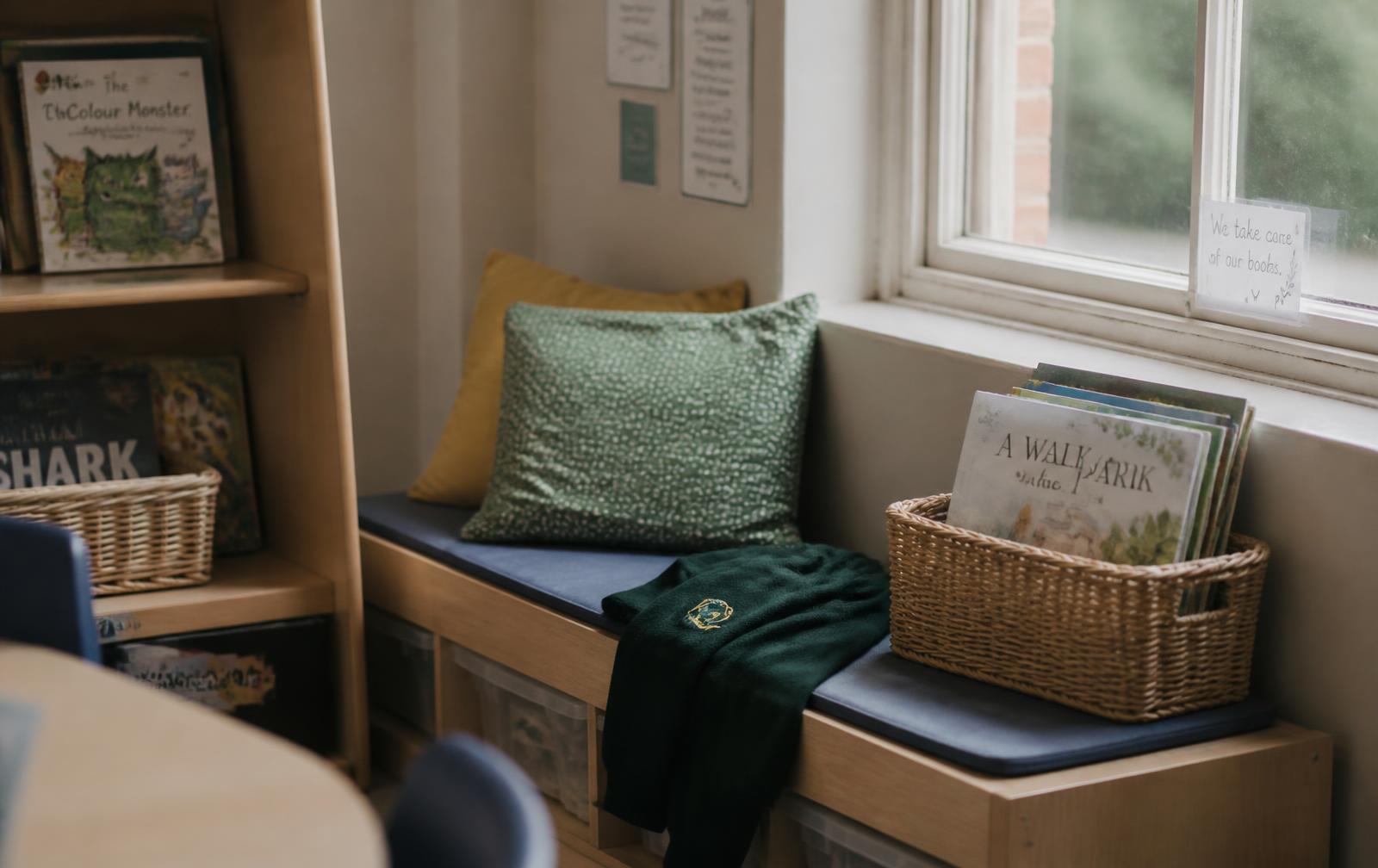
A quiet primary school book corner with a wooden bench, cushions and a basket of picture books beside a window in soft daylight.
Evidence guide · 15 min read

Emotional Regulation

Not the ability to stay calm. What emotional regulation actually involves, how it grows through relationships, and what genuinely helps at home and in class — with the strength of the evidence stated plainly.

Explore
A quiet primary school cloakroom with a single coat and book bag on a wooden peg rail in soft morning light.
Evidence guide · 15 min read

Anxiety & Worry

Most childhood worry is ordinary and passes. This guide is about telling the difference — what anxiety is, how it shows up when a child cannot name it, what genuinely helps, and when to involve someone else.

Explore
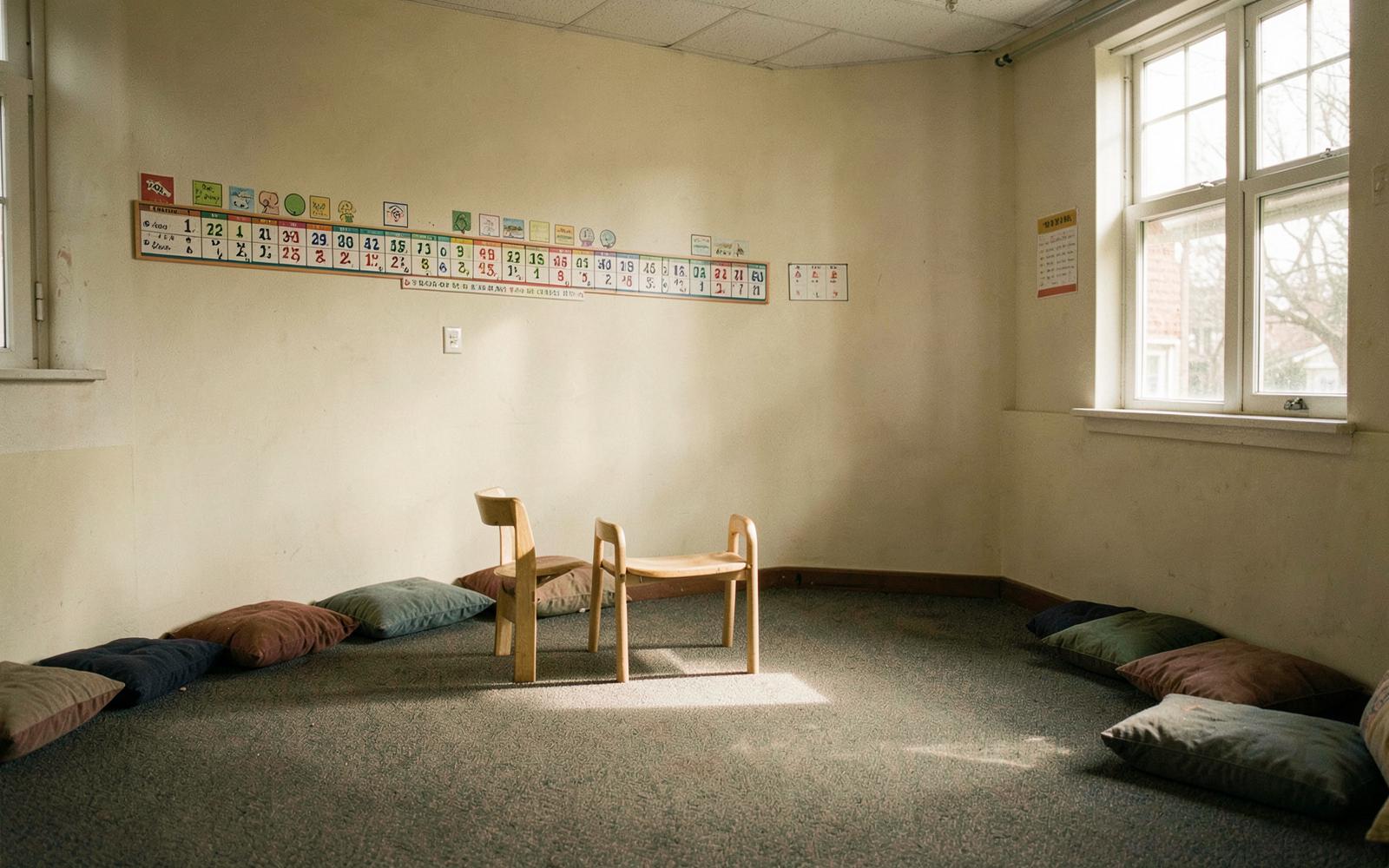
A quiet primary classroom carpet area with cushions and a low bookshelf in soft daylight.
Evidence guide · 16 min read

Understanding Behaviour

Behaviour is information. This guide looks at what tends to sit underneath it — need, context, relationship, communication, learning — and how to respond in a way that is both understanding and clear.

Explore
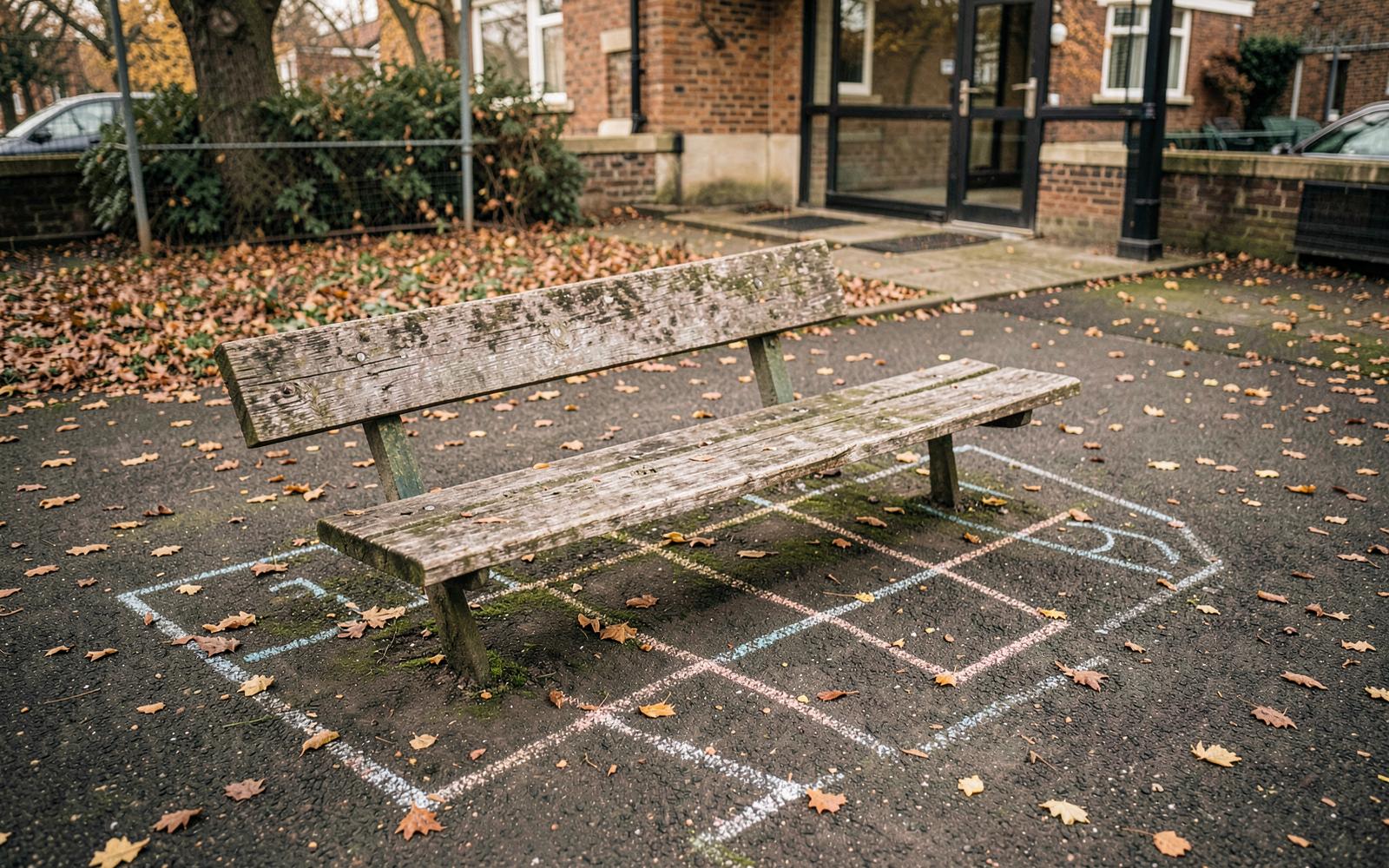
An empty wooden bench beside a primary school playground with a faded chalk hopscotch grid and autumn leaves.
Evidence guide · 15 min read

Relationships & Belonging

Why this is relevant

The confidence cost often outlasts the reading difficulty. This guide covers how standing in class is protected.

Explore
An empty primary school desk with a pencil pot and notebook beside a wooden chair with a wobble cushion, in soft morning light.
Evidence guide · 16 min read

ADHD

Attention, impulse and activity are shaped as much by the situation as by the child. This guide looks at what ADHD is, what it is not, and what actually helps in a mainstream primary classroom and at home.

Explore
A quiet corner of a primary classroom with a low wooden shelf of neatly arranged wooden blocks and a folded blanket beside a window.
Evidence guide · 17 min read

Autism

Autism is a difference in how a person communicates, experiences the world and makes sense of it — not a list of deficits. This guide looks at what may be relevant, what the environment contributes, and what genuinely helps in a mainstream primary school.

Explore
An adult's hand gently holding a young child's hand in soft natural light.
Evidence guide · 13 min read

School Attendance

When getting to school becomes the hardest part of the day. What can sit underneath attendance difficulties, how families and schools can work on it together, and what the guidance actually expects.

Explore
A calm, quiet reading corner in a primary classroom with cushions and soft daylight.
Evidence guide · 11 min read

Transitions

Moving from one thing to the next — between activities, places, people and years. Why change can be so hard for some children, and the calm, predictable preparation that helps.

Explore
Soft natural textures and calm materials arranged in gentle daylight.
Evidence guide · 11 min read

Sensory Needs

Some children experience noise, light, touch, smell or movement more — or less — intensely than others. What that can look like, why it matters for learning and wellbeing, and the calm adjustments that help.

Explore
A tidy wooden desk with a notebook and pencils in soft window light.
Evidence guide · 9 min read

Homework

Making home learning calmer for everyone. What the evidence says about primary homework, why it can be so hard after a long school day, and how families and schools can keep it purposeful rather than painful.

Explore
A parent and child sharing a picture book together in soft, warm light.
Evidence guide · 9 min read

Sleep

Small, steady changes that help a child settle and stay asleep — and why sleep matters so much for learning, mood and coping. Based on NHS advice.

Explore