
Evidence Guide
14 min read

Speech Sounds & Speech Clarity

Being hard to understand is not the same as having less to say. What speech sounds are, how clarity develops at different rates, and how to keep a child fully included while it does.

Reading time
14 min read
Age range
All primary (EYFS–KS2)
Evidence level
Moderate
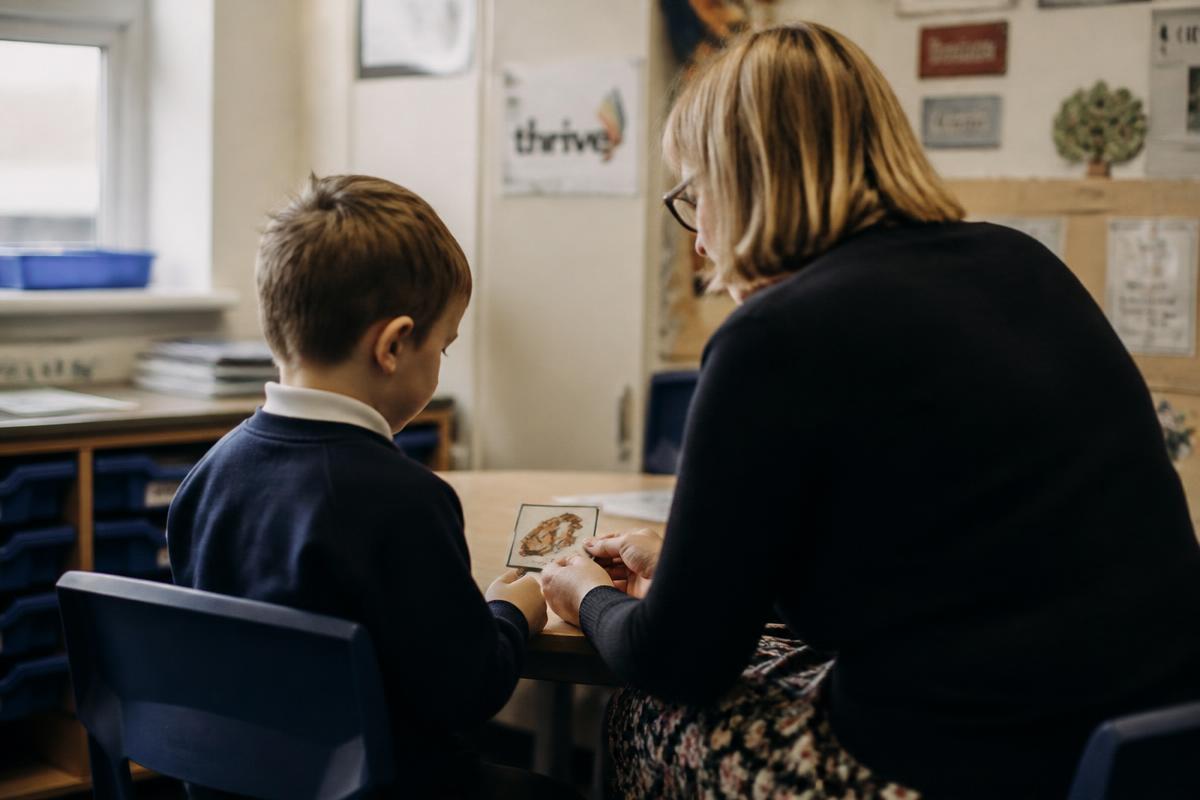
An adult and a young primary school child sitting side by side at a classroom table, looking together at a small picture card in soft window light.
MoreFor SENDCOs

Identification and initial picture

The first job is separating speech clarity from language and communication, because the provision differs. Gather intelligibility information from more than one listener — class teacher, a member of staff who does not know the child well, and the family — and note the difference between them. That gap is often the most informative single piece of evidence.

  • Who understands the child, in what settings, and how much of the time.
  • Whether the pattern is consistent (the same sound always affected) or variable.
  • Whether single words are clearer than connected speech.
  • Whether understanding and vocabulary look age-appropriate when speech is taken out of the equation.
  • Hearing history — otitis media, glue ear, grommets, last hearing check.
  • Home languages, and which sounds occur in each.
  • The child's own view of how talking is going.
Stay descriptive

Record patterns, not labels. 'Speech sound disorder' is a clinical umbrella term applied after assessment by a speech and language therapist — schools describe, therapists diagnose.


MoreFor SENDCOs

The graduated approach applied here

Assess

Intelligibility across listeners and settings, hearing status, receptive and expressive language, phonological awareness, and the child's confidence and participation.

Plan

Universal adjustments first: listening conditions, rehearsal routes, non-spoken response options, agreed classroom scripts for when adults do not understand. Add targeted work only where it is advised.

Do

Make the adjustments ordinary and consistent across all adults, including supply and lunchtime staff. Inconsistency is where most of this provision fails.

Review

Review against participation and intelligibility to unfamiliar listeners, not against a sound checklist. Termly is usually right.

The SEND Code of Practice places this in the communication and interaction area of need. Not every child with unclear speech needs to be on SEN support — many need well-made universal adjustments and time.

MoreFor SENDCOs

Working with speech and language therapy

NHS children's speech and language therapy assesses and treats speech sound difficulties. Referral routes and thresholds vary by area, and in many areas families can self-refer. Bercow: Ten Years On documented long and highly variable waits in England — plan on the assumption that a referral is the start of a process, not a solution.

  • Check the local referral route and criteria, and keep them somewhere staff can find them.
  • Refer with description and examples; recorded speech samples, with consent, are often more useful than forms.
  • Ask specifically what school should and should not do while waiting — including whether any sound-level practice is appropriate.
  • When a programme arrives, agree who delivers it, how often, where, and how it is recorded. Short, frequent and consistent beats long and occasional.
  • Feed classroom evidence back at review; therapists rarely see the child in a noisy room.
Boundary of practice

Schools deliver therapy-designed programmes; they do not design them. Choosing target sounds without assessment risks reinforcing an unhelpful pattern.

ProvisionFor SENDCOs

Provision that is usually proportionate

Universal

Listening conditions, modelling rather than correcting, rehearsal before public answers, non-spoken response options, a class culture of waiting.

Targeted

Small-group phonological awareness where that is the assessed gap; adult-supported rehearsal; confidence and participation work; agreed scripts for unfamiliar adults.

Specialist

Therapy-designed speech sound programmes, AAC or multimodal support where advised, and involvement for the small number of children with motor-speech difficulties such as CAS.

Be honest about evidence strength

The universal layer is well supported by DfE and EEF guidance on language-rich provision. The targeted layer for speech sounds specifically has a thinner school-based evidence base — which is an argument for therapy advice, not for doing nothing.

Monitoring impactFor SENDCOs

Monitoring impact

  • Proportion of utterances understood by an unfamiliar adult — sampled, not measured to a decimal point.
  • Frequency of voluntary contributions in class.
  • Gap between spoken and written or practical demonstration of the same objective.
  • Peer interaction at unstructured times.
  • The child's own report of how talking feels.

Avoid making the number of sounds 'acquired' the headline measure. It is the least sensitive to what school actually controls.

MisconceptionsFor SENDCOs

Common misconceptions to head off

How to weigh this evidence

Speech sound development is well described and the broad order sounds emerge is consistent across sources. What is far less certain is which classroom activity helps which child — targeted speech sound work is a clinical intervention, and the strongest evidence sits with speech and language therapists rather than with school programmes. We found no NICE guideline specific to children's speech sound disorders, so clinical points here lean on RCSLT and NHS guidance.

ResearchFor SENDCOs

Evidence & Sources

  1. Royal College of Speech and Language TherapistsProfessional guidance
    Speech sound disorders — clinical guidance (updated 2024)

    The UK professional reference point. Explains that 'speech sound disorder' is an umbrella term used when a child's speech is much harder to understand than other children of the same age speaking the same language, and that sub-types differ in cause and in what helps.

  2. Royal College of Speech and Language TherapistsProfessional guidance
    Position paper on Childhood Apraxia of Speech (CAS) (2024)

    Relevant only to a small minority of children. Useful for understanding why a few children need specialist, high-frequency motor-speech input rather than general classroom support.

  3. Speech and Language UKProfessional guidance
    Speech sounds (resource library for educators)

    Plain-English explanation for school staff, including the point that speech sounds are not letters — 'sheep' has five letters and three sounds.

  4. Speech and Language UKProfessional guidance
    Ages and stages

    Typical development by age band, with the standing caveat that children reach these stages at different rates. Use as a reference point, never as a checklist to score a child against.

  5. NHS (Berkshire Healthcare NHS Foundation Trust)Professional guidance
    Typical speech sound development

    NHS speech and language therapy advice on the order sounds usually emerge — early sounds such as b, m, d before later ones such as 'ch', 'th' and clusters. Local NHS services publish similar pages; referral routes vary by area.

  6. NHSProfessional guidance
    Glue ear

    Common in young children and can affect hearing while it lasts. One reason a hearing check is a sensible first step when speech is unclear.

  7. Department for EducationStatutory guidance
    SEND Code of Practice: 0 to 25 years (2015)

    Places speech, language and communication within the communication and interaction area of need, and sets out the graduated approach — assess, plan, do, review — schools must follow.

  8. Department for EducationStatutory guidance
    Early years foundation stage statutory framework (current version)

    Communication and language is a prime area; settings must provide a language-rich environment and back-and-forth interaction.

  9. Department for EducationProfessional guidance
    The reading framework: teaching the foundations of literacy (2021, updated 2023)

    Relevant because phonics teaching and assessment rest on hearing and producing sounds. It sets out how to teach and check phoneme–grapheme correspondence, which is where unclear speech can be misread as a phonics gap.

  10. Education Endowment FoundationResearch summary
    Preparing for Literacy: improving communication, language and literacy in the early years (2018)

    Recommends high-quality adult–child interaction and developing children's speech, language and communication. It is about the language environment, not about treating speech sound difficulties — that sits with speech and language therapy.

  11. Education Endowment FoundationResearch summary
    Improving Literacy in Key Stage 1 (2017, updated)

    Places phonological awareness and language capability among the foundations of early reading and writing.

  12. I CAN and RCSLTResearch summary
    Bercow: Ten Years On — an independent review of provision for children and young people with SLCN in England (2018)

    Documents variable identification and long waits for speech and language therapy in England, and argues for communication being everybody's business rather than a specialist add-on.

Supporting Families
Looking for a parent-friendly version of Speech Sounds & Speech Clarity?

The Kind Learner Space has this guide in plain English for families — the same evidence, translated for home.

Open in The Kind Learner Space
Continue exploring

Where to go next.

A calm handful of next steps — not a checklist. Follow whichever thread is most useful right now.

Related guides

A natural next thread.

For families

Share this at home.

A plain-English version parents and carers can read at home — same evidence, warmer language.

Browse by theme

Zoom out.

Sensory, attention, communication, wellbeing — see how this topic sits alongside the wider picture.

Learning pathway

Take the longer route.

Working memory, attention, executive function and cognitive load — threaded into one guided journey.

You may also find these helpful

Related Evidence Guides

Each guide below connects to the one you've just read. We've noted why — so you can follow the thread that matters most to you.

A stack of well-loved picture books beside a notebook on a wooden desk in soft window light.
Evidence guide · 12 min read

Working Memory

The mental notepad that lets a child hold information in mind long enough to use it — and the small changes that make the biggest difference.

Explore
A pegboard on a classroom wall with wooden name tags in warm afternoon light.
Evidence guide · 14 min read

Executive Function

Planning, flexibility and impulse control — the mental machinery that lets a developing brain get things done.

Explore
An open book and pencil on a classroom desk lit by low morning sunlight through a window.
Evidence guide · 11 min read

Attention

What we mean by attention, why it wanders, and the classroom conditions that help it hold.

Explore
A quiet primary classroom corner with soft natural light, uncluttered surfaces and calm materials.
Evidence guide · 11 min read

Cognitive Load

How lesson design shapes what a working memory can carry — and the small design choices that free up thinking for learning.

Explore
A child's small hands holding an autumn maple leaf in soft window light.
Evidence guide · 10 min read

Processing Speed

Why this is relevant

Rehearsing and repairing an unclear message takes time; extra thinking time protects participation.

Explore
A teacher crouched at eye level beside a young child at a classroom desk, pointing at a small visual card in soft window light.
Evidence guide · 13 min read

Understanding Spoken Language

Why this is relevant

Clarity is about output; this guide covers what a child takes in — the two are often confused and need different support.

Explore
A young primary school child talking animatedly to an adult across a classroom table in soft window light.
Evidence guide · 14 min read

Expressive Language

Why this is relevant

Finding and ordering words is separate from saying them clearly; many children need both looked at together.

Explore
An adult and a young primary school child sitting side by side over an open picture book in soft window light.
Evidence guide · 14 min read

Vocabulary & Word Knowledge

Why this is relevant

Unclear speech can hide the words a child actually has — word knowledge needs checking in ways that do not rely on clarity.

Explore
A quiet primary school book corner with a wooden bench, cushions and a basket of picture books beside a window in soft daylight.
Evidence guide · 15 min read

Emotional Regulation

Not the ability to stay calm. What emotional regulation actually involves, how it grows through relationships, and what genuinely helps at home and in class — with the strength of the evidence stated plainly.

Explore