Skip to content
Evidence Guide
16 min read

Understanding Behaviour

Behaviour is information. This guide looks at what tends to sit underneath it — need, context, relationship, communication, learning — and how to respond in a way that is both understanding and clear.

Reading time
16 min read
Age range
All primary (EYFS–KS2)
Evidence level
Moderate
A quiet primary classroom carpet area with cushions and a low bookshelf in soft daylight.
MoreFor leaders

Consistency and inclusion are not in tension

DfE behaviour advice expects clear routines and consistently applied expectations, and reasonable adjustments for pupils with SEND, and consideration of whether unmet needs are contributing. Schools that treat these as competing philosophies end up with either a policy that punishes need or a policy nobody can predict.

The workable version is a clear, universal set of expectations, with adjustment as a defined, recorded, leadership-sanctioned part of the policy rather than an informal concession by individual staff.

The test

Can every adult in the building say what the expectation is, what happens when it is not met, and what may legitimately be adjusted for a child with additional needs — and give the same answer?

OverviewFor leaders

What the evidence supports

EEF behaviour guidance points towards knowing pupils and their influences, explicit teaching of routines, consistent low-key responses, and targeted approaches for the small number who need them. Its toolkit rates behaviour interventions as moderate impact for very low cost on extensive evidence, while warning that effects vary widely and depend heavily on implementation.

The SEND guidance report and the primary SEL report add that high-quality teaching for all is the first line of response, and that social and emotional skills benefit from being taught rather than assumed. NICE NG223 aligns: supportive climate, trusted relationships, universal provision, targeted support.

MoreFor leaders

Reading your own data honestly

  • Who is receiving sanctions? Disaggregate by SEND, disadvantage, ethnicity, gender and year group.
  • Which lessons, times and places generate the most incidents? Environment and timetable are usually implicated.
  • Which staff are recording very high or very low numbers, and what does that tell you about support and training?
  • How many children are on part-time timetables, internal exclusion or repeated removal — and for how long?
  • How many suspended pupils had an identified SEMH or SEND need, and what adjustments were recorded first?
  • What is the repeat rate? A high one suggests the consequence is not teaching anything.
Disproportionality is a signal

If pupils with SEND are heavily over-represented in your sanction data, the most likely explanation is that the system is responding to unmet need rather than to choices. That is a leadership finding, not a pupil finding.

Leader guidanceFor leaders

Staff development and support

Consistency depends on confidence. EEF implementation evidence points to sustained professional development with modelling and follow-up, rather than one-off training. Lunchtime staff, teaching assistants and supply staff are usually the least trained and the most exposed.

  • Is there a shared script for common situations, practised rather than circulated?
  • Do staff know how to record antecedents, not just incidents?
  • Is there somewhere to raise a concern before it becomes a crisis?
  • Are staff debriefed and supported after serious incidents?
  • Is workload treated as part of behaviour culture? Tired adults are less consistent adults.
MoreFor leaders

Families, and the culture around them

Families of children with challenging behaviour are frequently contacted only with bad news, and arrive at meetings expecting blame. Schools that change this — a first positive contact, a jointly written plan, an agreed way of communicating — see fewer escalations and fewer complaints, and gain information they could not otherwise access.

It is worth checking what the child's experience of your systems actually is. Ask a small group of pupils who are frequently sanctioned what happens, whether they think it is fair, and what would help. The answers are usually specific and usually actionable.

MoreFor leaders

Questions worth asking your team

ResearchFor leaders

Evidence & sources

What this guide is, and is not

Understanding why a child behaves as they do does not mean removing expectations. This guide is about looking for what is underneath behaviour while still holding clear, kind boundaries — both, not one instead of the other. It is educational, not clinical, and it cannot tell you the cause of any individual child's behaviour.

  1. Department for EducationProfessional guidance
    Behaviour in schools: advice for headteachers and school staff (2024)

    The current DfE frame: clear routines and consistently applied expectations, alongside reasonable adjustments for pupils with SEND and consideration of whether unmet needs are driving behaviour.

  2. Department for EducationStatutory guidance
    SEND Code of Practice: 0 to 25 years (2015)

    States that behaviour is not itself a category of special educational need — where a child's behaviour is a concern, an underlying need should be looked for.

  3. Department for EducationProfessional guidance
    Mental health and behaviour in schools (2018)

    Non-statutory advice on recognising when behaviour reflects an underlying mental health or SEMH need, and where school support ends.

  4. Education Endowment FoundationResearch summary
    Improving Behaviour in Schools — guidance report (2019, updated 2021)

    Six recommendations, including knowing pupils and their influences, teaching routines explicitly, and using targeted approaches for the small number who need them.

  5. Education Endowment FoundationResearch summary
    Behaviour interventions — Teaching and Learning Toolkit

    Rated by the EEF as moderate impact for very low cost, on extensive evidence — with a strong caution that effects vary widely and depend on implementation.

  6. Education Endowment FoundationResearch summary
    Special Educational Needs in Mainstream Schools — guidance report (2020, updated 2021)

    Sets out the 'five-a-day' teaching approaches and argues that high-quality teaching for all is the first response to additional need, including SEMH need.

  7. Education Endowment FoundationResearch summary
    Improving Social and Emotional Learning in Primary Schools — guidance report (2019, updated 2021)

    Explicit teaching of social and emotional skills, reinforced across the day, is where much of the classroom behaviour evidence and the SEMH evidence overlap.

  8. Education Endowment FoundationResearch summary
    Putting Evidence to Work: A School's Guide to Implementation (2019, updated 2024)

    Why behaviour approaches most often fail: adopted broadly, delivered thinly, never reviewed.

  9. National Institute for Health and Care ExcellenceProfessional guidance
    Social, emotional and mental wellbeing in primary and secondary education (NG223) (2022)

    Whole-school approach, trusted relationships, and targeted support — the wellbeing counterpart to the behaviour guidance.

  10. Department for EducationStatutory guidance
    Keeping children safe in education

    A change in behaviour can be an indicator of a safeguarding concern. Any behaviour discussion must sit inside this duty.

  11. Anna FreudProfessional guidance
    Mentally Healthy Schools

    Quality-assured UK material on the relationship between behaviour, emotional need and school practice.

Supporting Families
Looking for a parent-friendly version of Understanding Behaviour?

The Kind Learner Space has this guide in plain English for families — the same evidence, translated for home.

Open in The Kind Learner Space
Continue exploring

Where to go next.

A calm handful of next steps — not a checklist. Follow whichever thread is most useful right now.

For families

Share this at home.

A plain-English version parents and carers can read at home — same evidence, warmer language.

Same category

More in Social, Emotional & Mental Health.

Emotional wellbeing, relationships, regulation, anxiety, trauma and belonging.

You may also find these helpful

Related Evidence Guides

Each guide below connects to the one you've just read. We've noted why — so you can follow the thread that matters most to you.

A stack of well-loved picture books beside a notebook on a wooden desk in soft window light.
Evidence guide · 12 min read

Working Memory

Why this is relevant

Forgotten instructions are frequently recorded as not listening; worth ruling out before anything else.

Explore
A pegboard on a classroom wall with wooden name tags in warm afternoon light.
Evidence guide · 14 min read

Executive Function

Why this is relevant

Waiting, stopping and switching are executive skills that develop unevenly and can be taught.

Explore
An open book and pencil on a classroom desk lit by low morning sunlight through a window.
Evidence guide · 11 min read

Attention

What we mean by attention, why it wanders, and the classroom conditions that help it hold.

Explore
A quiet primary classroom corner with soft natural light, uncluttered surfaces and calm materials.
Evidence guide · 11 min read

Cognitive Load

How lesson design shapes what a working memory can carry — and the small design choices that free up thinking for learning.

Explore
A child's small hands holding an autumn maple leaf in soft window light.
Evidence guide · 10 min read

Processing Speed

The pace at which a child takes in, makes sense of and responds to information — and why slower doesn't mean less capable.

Explore
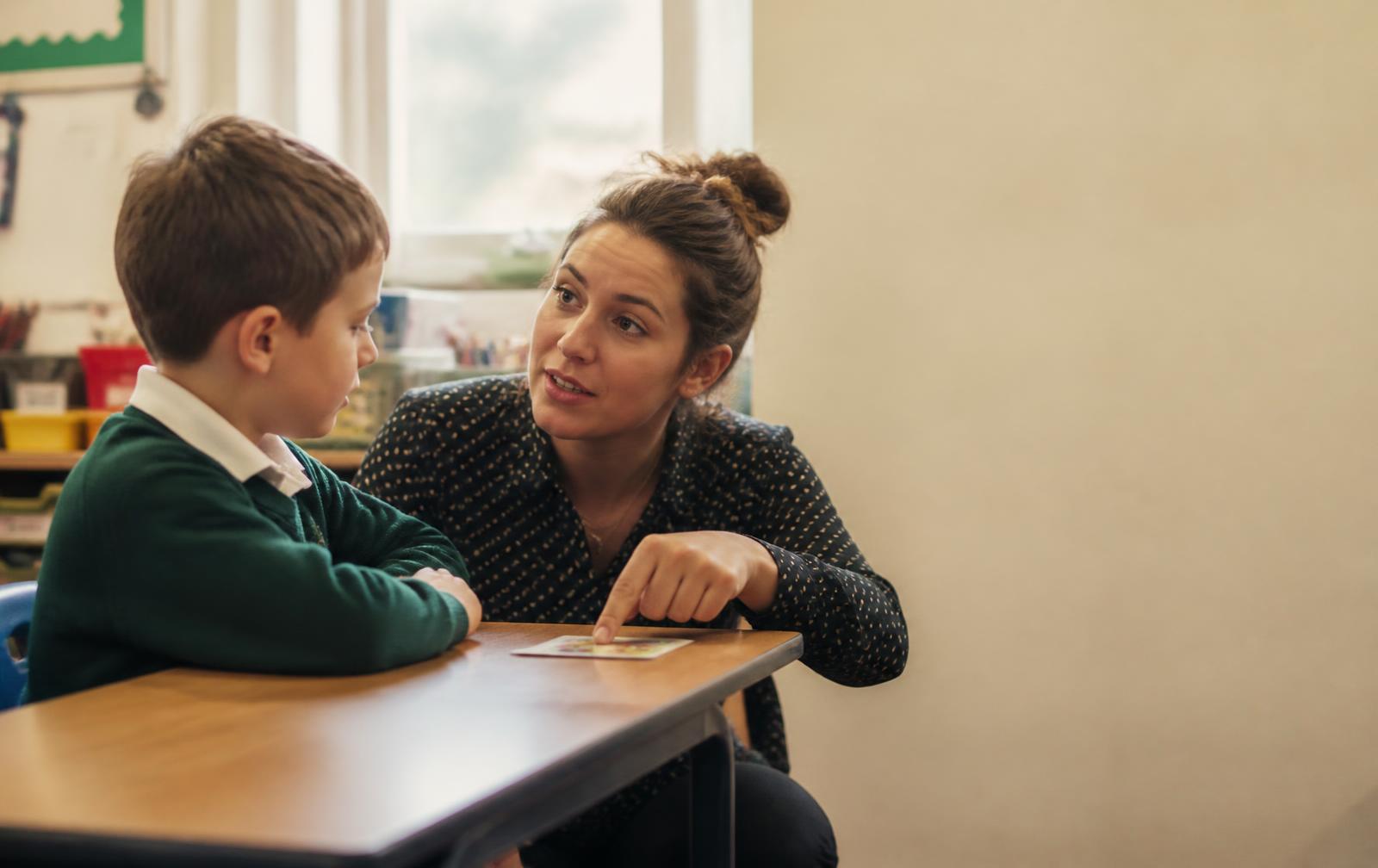
A teacher crouched at eye level beside a young child at a classroom desk, pointing at a small visual card in soft window light.
Evidence guide · 13 min read

Understanding Spoken Language

Why this is relevant

A child who cannot follow long instructions can look non-compliant when the barrier is comprehension.

Explore
A young primary school child talking animatedly to an adult across a classroom table in soft window light.
Evidence guide · 14 min read

Expressive Language

Why this is relevant

When words are hard to find, behaviour often carries the message instead.

Explore
An adult and a young primary school child sitting side by side over an open picture book in soft window light.
Evidence guide · 14 min read

Vocabulary & Word Knowledge

What it means to really know a word, why word knowledge sits underneath so much classroom learning, and how adults can build it deliberately without turning language into a deficit.

Explore
An adult and a young primary school child sitting side by side at a classroom table, looking together at a small picture card in soft window light.
Evidence guide · 14 min read

Speech Sounds & Speech Clarity

Being hard to understand is not the same as having less to say. What speech sounds are, how clarity develops at different rates, and how to keep a child fully included while it does.

Explore
A quiet primary school book corner with a wooden bench, cushions and a basket of picture books beside a window in soft daylight.
Evidence guide · 15 min read

Emotional Regulation

Why this is relevant

Much difficult behaviour is a feeling arriving faster than the skills to handle it.

Explore
A quiet primary school cloakroom with a single coat and book bag on a wooden peg rail in soft morning light.
Evidence guide · 15 min read

Anxiety & Worry

Why this is relevant

Refusal and avoidance are frequently anxiety in a form that looks like defiance.

Explore
An empty wooden bench beside a primary school playground with a faded chalk hopscotch grid and autumn leaves.
Evidence guide · 15 min read

Relationships & Belonging

Why this is relevant

Children behave differently for adults who know them; relationship is part of the behaviour picture, not separate from it.

Explore
An empty primary school desk with a pencil pot and notebook beside a wooden chair with a wobble cushion, in soft morning light.
Evidence guide · 16 min read

ADHD

Attention, impulse and activity are shaped as much by the situation as by the child. This guide looks at what ADHD is, what it is not, and what actually helps in a mainstream primary classroom and at home.

Explore
A quiet corner of a primary classroom with a low wooden shelf of neatly arranged wooden blocks and a folded blanket beside a window.
Evidence guide · 17 min read

Autism

Autism is a difference in how a person communicates, experiences the world and makes sense of it — not a list of deficits. This guide looks at what may be relevant, what the environment contributes, and what genuinely helps in a mainstream primary school.

Explore
An open book resting on a wooden primary school table beside a pencil and reading glasses in soft window light.
Evidence guide · 16 min read

Dyslexia

Dyslexia is about accurate, fluent word reading and spelling — not reversed letters or a visual learning style. This guide separates what is known from what is myth, and sets out the teaching and adjustments that actually help.

Explore
An adult's hand gently holding a young child's hand in soft natural light.
Evidence guide · 13 min read

School Attendance

When getting to school becomes the hardest part of the day. What can sit underneath attendance difficulties, how families and schools can work on it together, and what the guidance actually expects.

Explore
A calm, quiet reading corner in a primary classroom with cushions and soft daylight.
Evidence guide · 11 min read

Transitions

Moving from one thing to the next — between activities, places, people and years. Why change can be so hard for some children, and the calm, predictable preparation that helps.

Explore
Soft natural textures and calm materials arranged in gentle daylight.
Evidence guide · 11 min read

Sensory Needs

Some children experience noise, light, touch, smell or movement more — or less — intensely than others. What that can look like, why it matters for learning and wellbeing, and the calm adjustments that help.

Explore
A tidy wooden desk with a notebook and pencils in soft window light.
Evidence guide · 9 min read

Homework

Making home learning calmer for everyone. What the evidence says about primary homework, why it can be so hard after a long school day, and how families and schools can keep it purposeful rather than painful.

Explore
A parent and child sharing a picture book together in soft, warm light.
Evidence guide · 9 min read

Sleep

Small, steady changes that help a child settle and stay asleep — and why sleep matters so much for learning, mood and coping. Based on NHS advice.

Explore