
Evidence Guide
13 min read

Understanding Spoken Language

How children make sense of what adults say — and what we can change about the way we communicate so that more children understand, participate and show what they know.

Reading time
13 min read
Age range
All primary (EYFS–KS2)
Evidence level
High
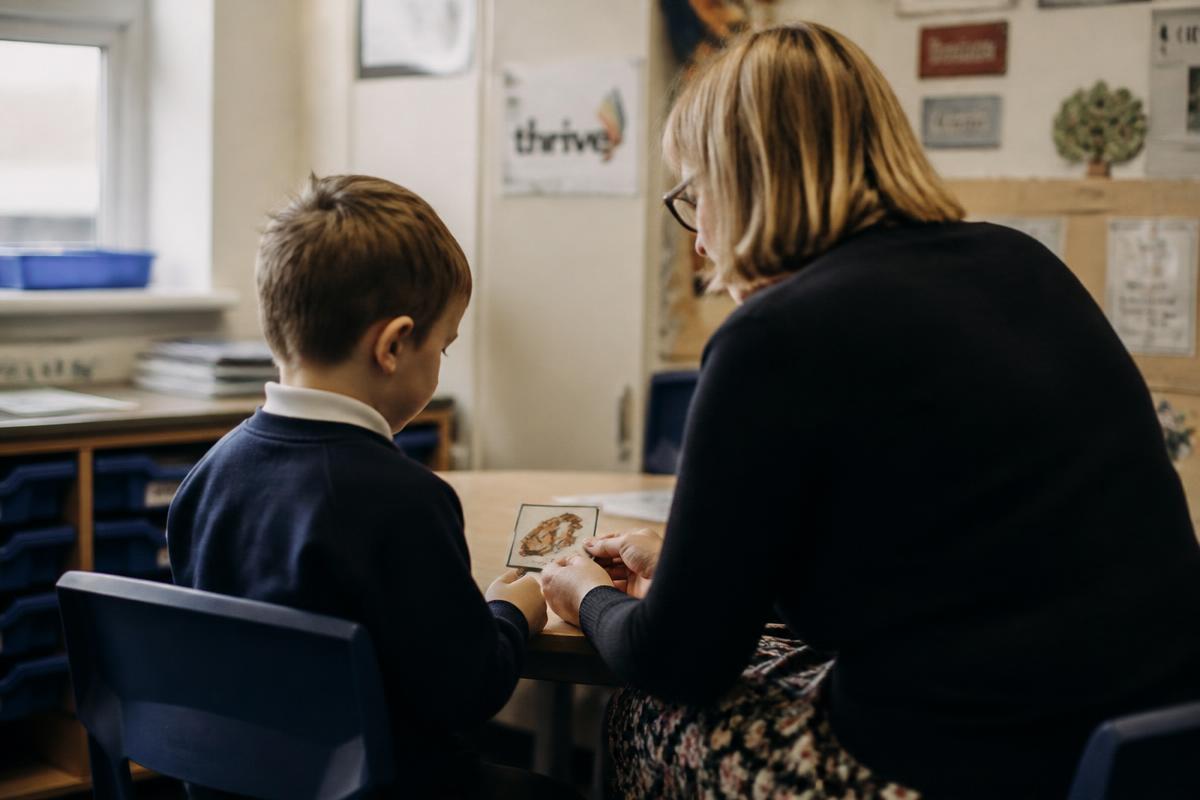
A teacher crouched at eye level beside a young child at a classroom desk, pointing at a small visual card in soft window light.
Leader guidanceFor leaders

Whole-school implications

Every lesson in your school is delivered through spoken language. If adult talk is long, fast and unsupported, a predictable group of children will lose access to the curriculum — and it will often be described as behaviour. Making communication a shared standard is one of the highest-leverage inclusion decisions a leadership team can take.

"When a child appears not to understand, the first question should be what might make the language easier to understand — not why the child isn't listening."

Leader guidanceFor leaders

Staff development

  • A shared model for instructions: get attention, say less, show it, give thinking time, check understanding.
  • Training for teaching assistants in processing time and checking, not just repeating.
  • Explicit vocabulary teaching as a curriculum expectation in every subject.
  • Coaching on teacher talk as a normal part of professional development.
Leader guidanceFor leaders

Curriculum and environment

  • Identify and sequence tier-two and subject vocabulary across the curriculum.
  • Acoustic and noise considerations in classrooms, halls and dining spaces.
  • Consistent visual supports — timetables, now/next, keyword displays that are used, not decorative.
  • Purposeful classroom talk built into planning, not left to chance.
Leader guidanceFor leaders

Strategic planning

  • Include communication access in learning walks and lesson observation lenses.
  • Review behaviour data for patterns that may reflect language access rather than conduct.
  • Build the speech and language therapy relationship before you need it.
  • Report on oral language as a school priority, with named leadership responsibility.
OverviewFor leaders

What good whole-school practice looks like

Across classrooms, staff consistently:

  • Use clear language.
  • Explain unfamiliar vocabulary.
  • Provide appropriate processing time.
  • Check understanding.
  • Use visuals purposefully.
  • Model language.
  • Create opportunities for meaningful talk.
  • Recognise that communication needs can affect behaviour and participation.
MoreFor leaders

Quality assurance questions

  • Are instructions generally clear and manageable?
  • Is vocabulary explicitly taught?
  • Are staff aware of the difference between hearing and understanding?
  • Are pupils given appropriate opportunities to rehearse language?
  • Are visual supports used purposefully?
  • Does staff training address communication and language?
  • Are communication needs considered when reviewing behaviour or attendance concerns?
Important leadership principle

Communication-supportive practice should not become a collection of additional tasks for individual teachers. The most sustainable approach is to build effective communication into everyday classroom practice.

"The aim is not to make every child communicate in the same way. The aim is to create classrooms in which children have meaningful opportunities to understand, participate and demonstrate what they know."
MoreFor leaders

Implementation guide

Teaching assistants support consistency by using the same language as the teacher, reinforcing rather than replacing teacher explanations, encouraging pupils to use visual supports, giving processing time, avoiding unnecessary repetition, and prompting pupils to explain or demonstrate their understanding.

Leaders can consider communication as part of teaching and learning, curriculum development, SEND provision, behaviour, attendance, staff development and inclusion.

1. Explore

Identify current strengths and areas for development.

2. Agree

Select a small number of consistent communication practices — for example: "We give important instructions in manageable steps and check understanding."

3. Model

Show staff what the agreed practice looks like.

4. Practise

Give staff opportunities to try the approach.

5. Observe

Look at what happens in real classrooms.

6. Reflect

Discuss what worked, what was difficult, which pupils benefited and what needs adapting.

7. Embed

Build successful approaches into everyday classroom routines.

Implementation warning

Avoid introducing too many communication strategies at once. A small number of well-understood practices are more likely to become embedded than a long checklist of expectations.

Whole-school principle

Communication support should be part of the way the school teaches, not something that happens only when a child is identified as having a communication difficulty.

Supporting Families
Looking for a parent-friendly version of Understanding Spoken Language?

The Kind Learner Space has this guide in plain English for families — the same evidence, translated for home.

Open in The Kind Learner Space
Continue exploring

Where to go next.

A calm handful of next steps — not a checklist. Follow whichever thread is most useful right now.

Related guides

A natural next thread.

For families

Share this at home.

A plain-English version parents and carers can read at home — same evidence, warmer language.

Browse by theme

Zoom out.

Sensory, attention, communication, wellbeing — see how this topic sits alongside the wider picture.

Learning pathway

Take the longer route.

Working memory, attention, executive function and cognitive load — threaded into one guided journey.

You may also find these helpful

Related Evidence Guides

Each guide below connects to the one you've just read. We've noted why — so you can follow the thread that matters most to you.

A stack of well-loved picture books beside a notebook on a wooden desk in soft window light.
Evidence guide · 12 min read

Working Memory

The mental notepad that lets a child hold information in mind long enough to use it — and the small changes that make the biggest difference.

Explore
A pegboard on a classroom wall with wooden name tags in warm afternoon light.
Evidence guide · 14 min read

Executive Function

Planning, flexibility and impulse control — the mental machinery that lets a developing brain get things done.

Explore
An open book and pencil on a classroom desk lit by low morning sunlight through a window.
Evidence guide · 11 min read

Attention

What we mean by attention, why it wanders, and the classroom conditions that help it hold.

Explore
A quiet primary classroom corner with soft natural light, uncluttered surfaces and calm materials.
Evidence guide · 11 min read

Cognitive Load

How lesson design shapes what a working memory can carry — and the small design choices that free up thinking for learning.

Explore
A child's small hands holding an autumn maple leaf in soft window light.
Evidence guide · 10 min read

Processing Speed

The pace at which a child takes in, makes sense of and responds to information — and why slower doesn't mean less capable.

Explore
A young primary school child talking animatedly to an adult across a classroom table in soft window light.
Evidence guide · 14 min read

Expressive Language

Why this is relevant

The other half of the picture: how children put their thoughts into words, and why output can lag far behind understanding.

Explore
An adult and a young primary school child sitting side by side over an open picture book in soft window light.
Evidence guide · 14 min read

Vocabulary & Word Knowledge

Why this is relevant

Understanding spoken language depends on knowing the words in it — an unfamiliar word is often where comprehension actually breaks.

Explore
An adult and a young primary school child sitting side by side at a classroom table, looking together at a small picture card in soft window light.
Evidence guide · 14 min read

Speech Sounds & Speech Clarity

Why this is relevant

How clearly a child speaks says nothing about how much they understand — this guide keeps the two apart.

Explore
A quiet primary school book corner with a wooden bench, cushions and a basket of picture books beside a window in soft daylight.
Evidence guide · 15 min read

Emotional Regulation

Not the ability to stay calm. What emotional regulation actually involves, how it grows through relationships, and what genuinely helps at home and in class — with the strength of the evidence stated plainly.

Explore