Evidence Guide
15 min read

Emotional Regulation

Not the ability to stay calm. What emotional regulation actually involves, how it grows through relationships, and what genuinely helps at home and in class — with the strength of the evidence stated plainly.

Reading time
15 min read
Age range
All primary (EYFS–KS2)
Evidence level
Moderate
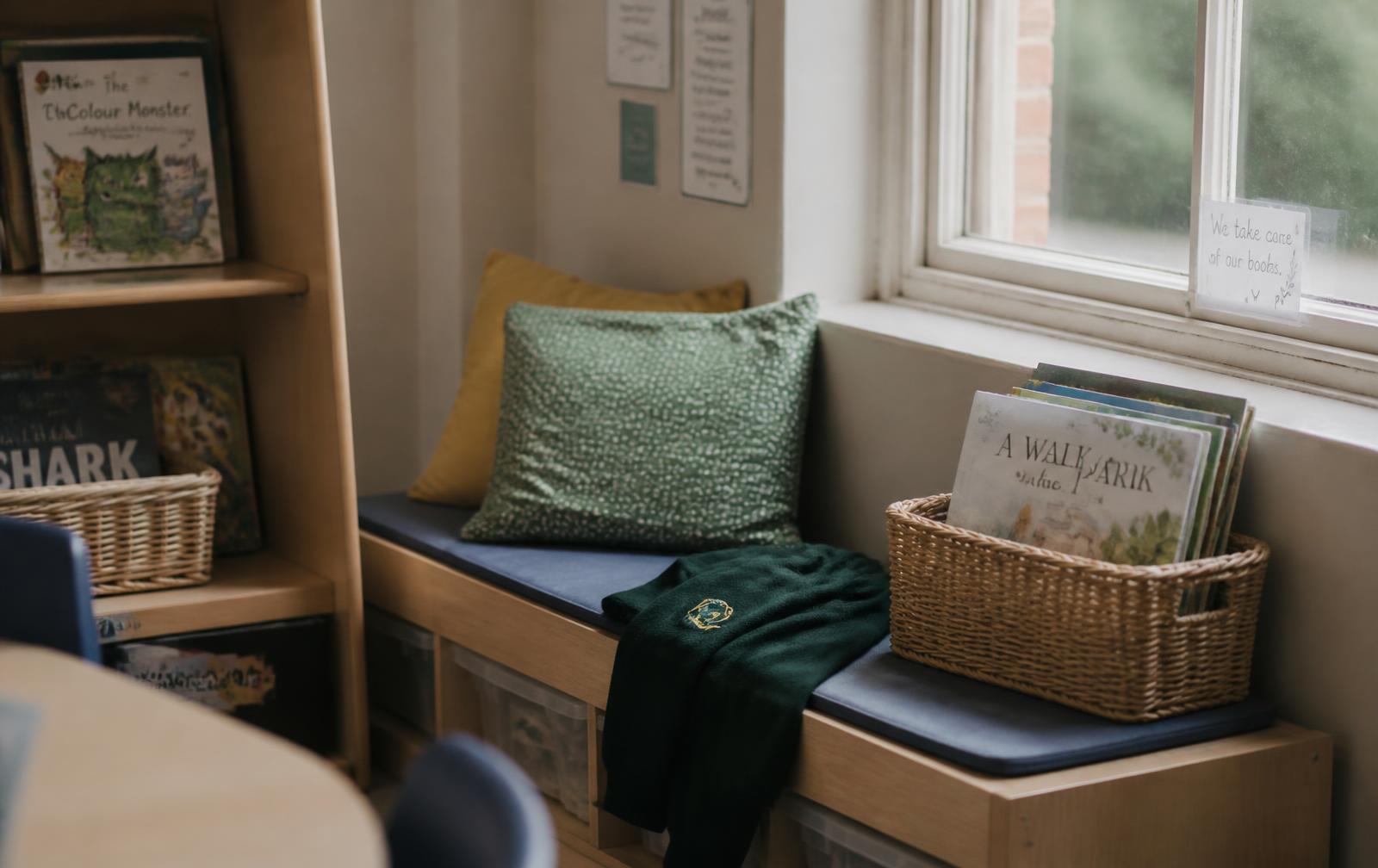
A quiet primary school book corner with a wooden bench, cushions and a basket of picture books beside a window in soft daylight.
Written for families

Plain English, no jargon. You don't need a teaching background to use this — just read the parts that feel useful and skip the rest. If something raises a question, your child's teacher or SENDCO is the best next step.

OverviewFor parents

What emotional regulation actually means

Emotional regulation is usually shortened to 'managing feelings', which makes it sound like a single skill children either have or lack. It is really a bundle of things developing at once: noticing a feeling, having words for it, understanding what set it off, being able to wait, being able to ask for help, and finding something that makes the feeling more bearable.

It is also not the same as being calm. A child who never shows distress is not necessarily regulating well — some children hold everything together at school and let it out at home, which is exhausting for them and hard for you.

Emotional regulation

Noticing, understanding and responding to feelings — including finding ways to cope when a feeling is strong. It develops over years, with help.

Co-regulation

A calm, familiar adult helping a child steady themselves. For primary-aged children this is not a lesser option; it is how regulation is learned.

Behaviour

What a child does. Emotion is one influence on it, alongside understanding, language, task demand, hunger, tiredness, relationships, sensory experience and the situation itself.

Compliance

Doing as asked. A quiet, compliant child may be coping well — or may be masking. Calm is not proof of regulation.

The aim is not a calm child

Feelings are part of being human, and children are meant to have them. The aim is a child who understands their feelings a little better each year and can keep taking part in life while they have them.

MoreFor parents

How it develops

Regulation grows slowly, over the whole of childhood and well into adolescence. Very young children rely almost entirely on an adult to steady them. Through the primary years children gradually take on more of that job themselves — but unevenly, and they lose ground when tired, unwell, hungry, worried or somewhere unfamiliar.

The way children learn it is mostly through being helped: thousands of ordinary moments of an adult staying steady, naming what happened and helping put things right afterwards. This is what professionals mean by co-regulation.

Going backwards is normal

A seven-year-old who managed something last month and cannot manage it today has not lost a skill. Regulation is very sensitive to circumstances — a new baby, a house move, a poor night's sleep, a hard week at school.

OverviewFor parents

What you might notice

  • Feelings arrive fast and at full volume, with little warning.
  • Small changes of plan feel enormous.
  • It takes a long time to come back down after being upset.
  • They hold it together all day at school and fall apart at the door.
  • They find it hard to say what is wrong, even when they want to.
  • They avoid situations that have gone badly before.
  • Afterwards they are ashamed, and say things like "I'm the worst".

Noticing these things is useful information, not a diagnosis. Writing down what happened, when, and what was going on beforehand is far more helpful to a teacher or a professional than trying to name a condition.

MoreFor parents

Why this can be harder for some children

There is rarely one reason. Children differ from birth in how strongly they react and how quickly they settle. Some are managing demands adults cannot see: understanding language, keeping up with work, noise, hunger, worry about a friendship, or a long day of holding themselves together.

Difficulty finding words matters more than people expect. A child who cannot yet explain a feeling has fewer options than shouting or leaving. Tiredness, illness, hunger and change all reduce anyone's capacity — adults included.

Not a character judgement

Words like 'attention-seeking', 'manipulative' or 'lacking resilience' describe an adult's interpretation, not a child. They also close down the more useful question: what is making this hard right now?

OverviewFor parents

What helps at home

Be the steady one

What it is: staying calm and close while your child is upset, saying little. Why it may help: children borrow an adult's steadiness before they build their own. When: during the storm, when nothing else is going to land. Limits: it is genuinely hard when you are depleted, and no parent manages it every time.

Make the day predictable

What it is: the same broad shape to mornings, evenings and bedtimes, and a warning before things change. Why: much distress comes from not knowing what is coming. What it looks like: "Ten more minutes, then bath" rather than a sudden stop.

Give feelings ordinary words

What it is: naming feelings — yours as well as theirs — as they come up. Why: the EEF's guidance identifies explicit teaching of emotional vocabulary as part of effective social and emotional learning. Limits: naming a feeling in the middle of a meltdown often adds pressure. It works better in calm moments and afterwards.

Talk it through afterwards, not during

What it is: a short, blame-free conversation once everyone has settled — what happened, what might help next time. Why: this is when children can actually think. What to avoid: a post-mortem that becomes a telling-off.

Repair the relationship

What it is: making it clear the relationship is intact after a difficult moment, including apologising when you lost your temper. Why: it teaches that mistakes are survivable and reduces shame.

Protect sleep, food and downtime

What it is: unglamorous but real. Why: capacity for coping drops sharply when children are tired or hungry, and after a full school day many children have nothing left.

Reduce demands where you sensibly can

What it is: dropping something optional in a hard week. Why: capacity is finite. Limits: this is temporary support, not a permanent removal of everything difficult — children also need to meet manageable challenges.

MoreFor parents

About calm boxes, breathing and fidget toys

Breathing exercises, sensory items, feelings charts and calm corners suit some children in some situations. They are not reliable solutions and there is no strong UK evidence that any of them works for children in general.

If something helps your child, use it. If it does not, that is not a failure on their part. It is usually more useful to understand when things go wrong, and why, than to keep adding tools.

Be wary of confident brain claims

A lot of popular advice — 'flipping your lid', upstairs and downstairs brains, nervous-system explanations — is a metaphor or a therapeutic model rather than established evidence about children. Some people find the metaphors useful. They are not a reason to trust the advice attached to them.

Support at homeFor parents

Things to avoid

  • Reasoning at length while your child is still overwhelmed — very little of it is taken in.
  • Consequences decided in the heat of the moment.
  • Discussing what happened in front of other people.
  • Treating every difficult moment as a sign of something serious.
  • Expecting a strategy that worked once to work every time.
  • Assuming that because school reports no problems, nothing is happening.
MoreFor parents

When to ask for more help

It is reasonable to ask for advice at any point. It is particularly worth doing when difficulties are frequent and persistent, when they happen in more than one setting, when your child is very distressed, avoiding school or withdrawing from things they used to enjoy, or when family life is dominated by managing feelings.

  • Start with your child's teacher or the school's SENDCO — describe examples and ask what they see.
  • Your GP can advise and, where appropriate, refer to local children and young people's mental health services.
  • Many areas have school-based mental health support teams, school counselling or early-help services; school can tell you what exists locally.
  • NHS advice for parents covers common worries, including anxiety in children, and what to do next.
If you are worried about immediate safety

If your child is at risk of harming themselves, contact your GP, NHS 111, or emergency services. This guide is educational and is not a substitute for medical advice.

ResearchFor parents

Evidence & sources

How confident is this evidence?

Moderate at best, and honestly so. The EEF rates social and emotional learning as moderate impact based on moderate evidence, and the underpinning review found effects that vary widely between studies. NICE recommends whole-school approaches and trusted relationships. What follows is written at that level of confidence: worth doing, likely to help, not guaranteed for any individual child.

  1. Education Endowment FoundationResearch summary
    Improving Social and Emotional Learning in Primary Schools — guidance report (2019, updated 2021)

    The main UK education reference for this area. Recommends teaching social and emotional skills explicitly, embedding them in everyday teaching, and planning implementation carefully — rather than buying a programme and hoping.

  2. Education Endowment FoundationResearch summary
    Social and emotional learning (Teaching and Learning Toolkit)

    Summarised by the EEF as moderate impact for very low cost, based on moderate evidence. Worth reading before describing any approach here as proven.

  3. Wigelsworth, Verity, Mason, Humphrey, Qualter & Troncoso (University of Manchester), for the EEFResearch evidence
    Programmes to Practices: identifying effective, evidence-based social and emotional learning strategies — evidence review (2020)

    The review underpinning the guidance report. Notes that effects vary widely between studies and that how an approach is implemented matters as much as which approach is chosen.

  4. Department for EducationProfessional guidance
    Mental health and behaviour in schools (2018)

    Non-statutory advice on how schools can support pupils whose mental health affects their behaviour and learning, and on the line between school support and clinical services.

  5. Department for EducationProfessional guidance
    Behaviour in schools: advice for headteachers and school staff (2022, updated 2024)

    Sets the expectation that behaviour policies are applied consistently and that reasonable adjustments are considered for pupils with SEND — the two things schools most often have to hold together.

  6. Department for EducationStatutory guidance
    SEND Code of Practice: 0 to 25 years (2015)

    Defines social, emotional and mental health as one of the four broad areas of need, and sets out the graduated approach — assess, plan, do, review — that schools must follow.

  7. Department for Education (research by University College London)Research evidence
    Identifying and supporting children and young people with social, emotional and mental health needs: a rapid evidence review (2025)

    Part of the DfE's SEND evidence programme. Published as research, not policy — the DfE states it does not endorse the approaches described.

  8. Department for Education (research by University College London)Research evidence
    Behavioural and social communication interventions for children and young people with SEMH and autism: a rapid evidence review (2026)

    Reviews what is known about behavioural and social communication approaches for these groups. Again published as evidence rather than endorsement, and the reviewers are careful about the limits of the studies available.

  9. Department for EducationResearch evidence
    Identifying and supporting the needs of children with SEND in mainstream settings (2025)

    The collection page for the rapid evidence reviews above, including cross-cutting themes on identification and collaboration.

  10. National Institute for Health and Care ExcellenceProfessional guidance
    Social, emotional and mental wellbeing in primary and secondary education (NG223) (2022)

    Recommends a whole-school approach with a supportive climate and trusted relationships, universal curriculum content on social and emotional skills, and targeted support for children who need more — with staff training to deliver it.

  11. Public Health England / Department for EducationProfessional guidance
    Promoting children and young people's mental health and wellbeing: a whole-school and whole-college approach (2021)

    The eight-principle framework most UK schools use to audit their wellbeing provision — leadership, ethos, curriculum, pupil voice, staff development, identifying need, working with parents, targeted support.

  12. NHSProfessional guidance
    Children and young people's mental health — advice for parents

    Plain-English NHS advice for families, including anxiety in children and how to seek help through a GP or local children and young people's mental health services.

  13. Anna FreudProfessional guidance
    Resources for schools and colleges

    Free UK resources from a children's mental health charity, including practical materials for whole-school approaches and for staff wellbeing.

  14. Anna FreudProfessional guidance
    Mentally Healthy Schools

    Quality-assured resource bank for UK primary schools, useful when choosing classroom materials that are not simply commercial products.

Supporting School
Curious how school approaches emotional regulation?

The professional Evidence Library shows the same ideas written for teachers, SENDCOs and school leaders.

Open the Evidence Library
Continue exploring

Where to go next.

A calm handful of next steps — not a checklist. Follow whichever thread is most useful right now.

For the classroom

What school is doing.

See the same evidence translated for teachers, so home and school can pull in the same direction.

Browse by theme

Zoom out.

Sensory, attention, communication, wellbeing — see how this topic sits alongside the wider picture.

Learning pathway

Take the longer route.

Working memory, attention, executive function and cognitive load — threaded into one guided journey.

You may also find these helpful

Related Evidence Guides

Each guide below connects to the one you've just read. We've noted why — so you can follow the thread that matters most to you.

A stack of well-loved picture books beside a notebook on a wooden desk in soft window light.
Evidence guide · 12 min read

Working Memory

The mental notepad that lets a child hold information in mind long enough to use it — and the small changes that make the biggest difference.

Explore
A pegboard on a classroom wall with wooden name tags in warm afternoon light.
Evidence guide · 14 min read

Executive Function

Why this is relevant

Stopping, waiting, switching and starting again are executive skills — they get harder for everyone under emotional load.

Explore
An open book and pencil on a classroom desk lit by low morning sunlight through a window.
Evidence guide · 11 min read

Attention

Why this is relevant

Distress and attention compete for the same limited capacity; what looks like not listening is often a child managing a feeling.

Explore
A quiet primary classroom corner with soft natural light, uncluttered surfaces and calm materials.
Evidence guide · 11 min read

Cognitive Load

Why this is relevant

Work pitched too high is a common cause of distress; checking task demand comes before treating a pattern as emotional.

Explore
A child's small hands holding an autumn maple leaf in soft window light.
Evidence guide · 10 min read

Processing Speed

The pace at which a child takes in, makes sense of and responds to information — and why slower doesn't mean less capable.

Explore
A teacher crouched at eye level beside a young child at a classroom desk, pointing at a small visual card in soft window light.
Evidence guide · 13 min read

Understanding Spoken Language

Why this is relevant

Long verbal explanations during a difficult moment ask most of the skill a child has least access to just then.

Explore
A young primary school child talking animatedly to an adult across a classroom table in soft window light.
Evidence guide · 14 min read

Expressive Language

Why this is relevant

A child who cannot yet put a feeling into words has fewer options than shouting or leaving.

Explore
An adult and a young primary school child sitting side by side over an open picture book in soft window light.
Evidence guide · 14 min read

Vocabulary & Word Knowledge

What it means to really know a word, why word knowledge sits underneath so much classroom learning, and how adults can build it deliberately without turning language into a deficit.

Explore
An adult and a young primary school child sitting side by side at a classroom table, looking together at a small picture card in soft window light.
Evidence guide · 14 min read

Speech Sounds & Speech Clarity

Being hard to understand is not the same as having less to say. What speech sounds are, how clarity develops at different rates, and how to keep a child fully included while it does.

Explore