Evidence Guide
14 min read

Expressive Language

How children put their thoughts, ideas, needs and experiences into words — and what adults can change so that more children can show what they think and know.

Reading time
14 min read
Age range
All primary (EYFS–KS2)
Evidence level
High
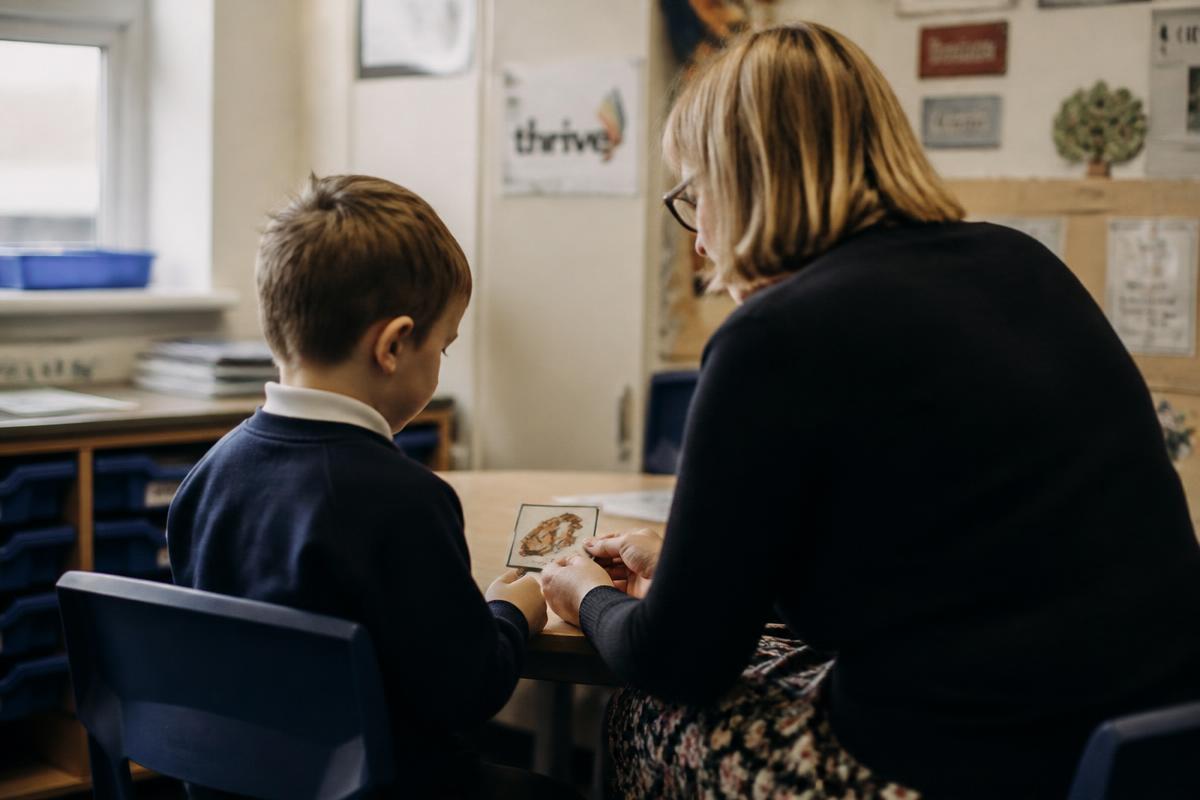
A young primary school child talking animatedly to an adult across a classroom table in soft window light.
Written for families

Plain English, no jargon. You don't need a teaching background to use this — just read the parts that feel useful and skip the rest. If something raises a question, your child's teacher or SENDCO is the best next step.

OverviewFor parents

What expressive language means

Expressive language is how a child puts thoughts, ideas, feelings and needs into words — the vocabulary they can reach for, the way they build sentences, and how they string events together to tell you something that happened.

It is not the same as speech. Speech is about making sounds clearly. A child can be perfectly easy to understand and still find it hard to find the right word, or hard to explain something in order. Another child may have plenty to say and be difficult to understand. They are different things, and they need different kinds of help.

In one sentence

Understanding is what goes in; expressive language is what comes out — and for many children the gap between the two is real, wide and easy to misread.

Children also express themselves in more ways than speech. Gesture, drawing, signing, writing, pointing at pictures and communication aids all carry meaning. The Royal College of Speech and Language Therapists is clear that these supports help children communicate — and that using them does not stop speech developing.

Signs you may noticeFor parents

Signs you might notice at home

None of these on its own means anything is wrong. Children develop at very different rates. They are simply worth noticing, and worth mentioning to school if you see them often.

  • Uses shorter sentences than other children of a similar age.
  • Reaches for "thing", "stuff", "that one" rather than the word they want.
  • Tells you about their day out of order, so it is hard to follow.
  • Starts a sentence, stops, and gives up on it.
  • Answers questions with one word when you know they have plenty to say.
  • Talks freely at home and hardly at all at school, or the other way round.
  • Gets frustrated, cross or quiet when they cannot make themselves understood.
  • Shows you rather than tells you — leading you by the hand, pointing, acting it out.
A strength, not a symptom

Showing you instead of telling you is good communication. A child working hard to get a message across is doing something impressive, not something wrong.

Support at homeFor parents

Everyday examples

"What did you do today?"

An open question with no starting point. A child who finds ordering ideas hard has nowhere to begin. "Who did you sit with at lunch?" gives them a foothold — and often more comes after it.

Falling out with a friend

Explaining what happened means putting events in order and describing what someone else did and felt. That is a genuinely hard language task in the middle of feeling upset.

Talking to the doctor

Unfamiliar adult, pressure to answer, words that are hard to find. Many children go silent — which is not the same as having nothing to say.

Support at homeFor parents

Practical ideas to try

Add a little, don't correct

If your child says "him goed park", you can reply "yes — he went to the park!" They hear the fuller version without being told they got it wrong. This is sometimes called recasting.

Comment more than you question

A run of questions can feel like a test. Saying what you can see — "that tower is getting really tall" — gives them language to borrow with no pressure to perform.

Offer a choice

"Was it annoying or was it funny?" gives a child the word to reach for. Choices are easier than open questions when finding words is the hard part.

Give a proper pause

Count to ten silently before filling the gap. Many children need considerably longer than adults expect to gather what they want to say.

Use the pictures you already have

Looking back through photos on your phone gives a shared thing to talk about, in order, with the memory already in front of you.

Meet new words more than once

A word met once is rarely kept. Notice one interesting word from a book or the day, use it again tomorrow, and again later in the week.

Support at homeFor parents

Things to avoid

  • Asking a child to "say it properly" before they are allowed what they asked for.
  • Finishing sentences for them out of kindness — it is worth waiting a little longer.
  • Correcting grammar directly and often; modelling the fuller version works better and costs the child nothing.
  • Comparing them with a sibling or a friend's child out loud.
  • Reading a list of signs and concluding your child has a particular condition. A checklist cannot tell you that.
You have not caused this

Differences in how children develop language have many causes and are usually nothing to do with how much a parent talks to their child. If you are worried, that worry is worth acting on — but it is not evidence that you have done something wrong.

MoreFor parents

When to seek more advice

There is no single moment at which you should worry. But it is reasonable to ask for advice if your child's difficulty getting words out is persistent, happens across home and school, and is affecting how they learn, play or feel.

  • Start with your child's teacher — describe what you notice, with examples.
  • The school's SENDCO can look at whether adjustments are needed and whether the same picture appears across the school day.
  • Your GP or health visitor can refer to NHS speech and language therapy; in many areas families can also refer themselves.
  • A hearing check is always worth doing if it has been a while.
Support does not require a diagnosis

The SEND Code of Practice expects schools to respond to need as it appears, not to wait for a label. Adjustments can start now.

MoreFor parents

Where this guidance comes from

How to read the evidence

Some of what follows is statutory guidance schools must follow, some is a synthesis of research, and some is professional practice that is widely recommended but not separately trialled. We have tried to say which is which. The EEF rates oral language approaches as high impact for very low cost on extensive evidence — but it has not published separate effect sizes for individual techniques such as sentence starters or extra thinking time. Those sit inside the broader picture; treating any one of them as independently proven would overstate what the evidence shows.

  1. Department for EducationStatutory guidance
    SEND Code of Practice: 0 to 25 years (2015)

    Names communication and interaction — including speech, language and communication needs — as one of the four broad areas of SEN, and sets out the graduated approach schools must follow.

  2. Department for EducationStatutory guidance
    Early years foundation stage statutory framework (current version)

    Communication and language is one of three prime areas; providers must give children a language-rich environment and opportunities to express themselves.

  3. Department for EducationProfessional guidance
    Development Matters: non-statutory curriculum guidance for the EYFS (2023 revision)

    Describes typical progression in listening, understanding and speaking. Explicitly not a checklist, and not statutory.

  4. Education Endowment FoundationResearch summary
    Oral language interventions (Teaching and Learning Toolkit)

    Rates oral language approaches as high impact for very low cost, based on extensive evidence. The Toolkit is periodically revised, so check the live page for the current impact estimate rather than quoting an older figure.

  5. Education Endowment FoundationResearch summary
    Preparing for Literacy: improving communication, language and literacy in the early years (2018)

    Recommends high-quality adult–child interaction and structured language development, and notes the recommendations may also apply to older pupils who have fallen behind.

  6. Education Endowment FoundationResearch summary
    Improving Literacy in Key Stage 1 (2017, updated)

    Places developing pupils' language capability — vocabulary, listening and structured talk — among the foundations of early reading and writing.

  7. Education Endowment FoundationResearch summary
    Improving Literacy in Key Stage 2 (2017, updated 2021)

    Links spoken vocabulary and structured discussion to reading comprehension and writing composition across KS2.

  8. Royal College of Speech and Language TherapistsProfessional guidance
    Clinical information: developmental language disorder (DLD)

    States that DLD affects around 7.6% of children — roughly two in a class of thirty — and describes its impact on understanding and using language.

  9. Norbury, Gooch, Wray, Baird, Charman, Simonoff, Vamvakas & PicklesResearch evidence
    The impact of nonverbal ability on prevalence and clinical presentation of language disorder (SCALES study), Journal of Child Psychology and Psychiatry (2016)

    The peer-reviewed population study behind the 7.6% figure. It concerns language disorder overall — receptive and expressive — not expressive difficulties in isolation.

  10. Royal College of Speech and Language TherapistsProfessional guidance
    Augmentative and Alternative Communication (AAC): position statement (2024)

    Defines AAC — signing, symbols, boards, speech-generating devices — and summarises the evidence base. States that AAC supports rather than delays spoken language.

  11. Royal College of Speech and Language TherapistsProfessional guidance
    Augmentative and Alternative Communication: overview (2024)

    Plain-language explanation of AAC for families and school staff.

  12. Speech and Language UKProfessional guidance
    Ages and Stages

    Qualitative descriptions of typical speech, language and communication development by age band. Ranges, not norms — individual variation is expected.

  13. NICEProfessional guidance
    Early years: promoting health and wellbeing in under 5s (QS128), quality statement 2: speech and language (2016)

    Its rationale notes that children with communication difficulties are at increased risk of social, emotional and behavioural difficulties. The statement itself concerns early identification, not primary-age provision.

  14. I CAN and RCSLTProfessional guidance
    Bercow: Ten Years On — an independent review of provision for children and young people with SLCN (2018)

    National review finding awareness of communication needs low and provision across England uneven, with recommendations on identification, workforce and whole-school practice.

  15. Public Health EnglandProfessional guidance
    Best start in speech, language and communication (2020)

    Guidance and supporting evidence on early identification of communication needs. Early-years focused; useful background for primary schools working with feeder settings.


Supporting School
Curious how school approaches expressive language?

The professional Evidence Library shows the same ideas written for teachers, SENDCOs and school leaders.

Open the Evidence Library
Continue exploring

Where to go next.

A calm handful of next steps — not a checklist. Follow whichever thread is most useful right now.

For the classroom

What school is doing.

See the same evidence translated for teachers, so home and school can pull in the same direction.

Browse by theme

Zoom out.

Sensory, attention, communication, wellbeing — see how this topic sits alongside the wider picture.

Learning pathway

Take the longer route.

Working memory, attention, executive function and cognitive load — threaded into one guided journey.

You may also find these helpful

Related Evidence Guides

Each guide below connects to the one you've just read. We've noted why — so you can follow the thread that matters most to you.

A stack of well-loved picture books beside a notebook on a wooden desk in soft window light.
Evidence guide · 12 min read

Working Memory

Why this is relevant

Holding a sentence in mind while composing it draws directly on working memory, so ideas can be lost mid-utterance.

Explore
A pegboard on a classroom wall with wooden name tags in warm afternoon light.
Evidence guide · 14 min read

Executive Function

Why this is relevant

Sequencing a recount or planning an explanation is an executive task as much as a language one.

Explore
An open book and pencil on a classroom desk lit by low morning sunlight through a window.
Evidence guide · 11 min read

Attention

Why this is relevant

Producing extended talk demands sustained attention, and difficulty expressing ideas often surfaces as disengagement.

Explore
A quiet primary classroom corner with soft natural light, uncluttered surfaces and calm materials.
Evidence guide · 11 min read

Cognitive Load

Why this is relevant

Composing and transcribing at the same time overloads capacity — saying it before writing it splits the demand.

Explore
A child's small hands holding an autumn maple leaf in soft window light.
Evidence guide · 10 min read

Processing Speed

Why this is relevant

Word-finding takes time — extra thinking time supports children whose processing is slower as well as those searching for words.

Explore
A teacher crouched at eye level beside a young child at a classroom desk, pointing at a small visual card in soft window light.
Evidence guide · 13 min read

Understanding Spoken Language

Why this is relevant

Understanding and expression are separate skills that often diverge — check both before drawing conclusions about a child.

Explore
An adult and a young primary school child sitting side by side over an open picture book in soft window light.
Evidence guide · 14 min read

Vocabulary & Word Knowledge

Why this is relevant

Children can only say what they have words for; word-finding and vocabulary depth sit directly behind expressive difficulty.

Explore
An adult and a young primary school child sitting side by side at a classroom table, looking together at a small picture card in soft window light.
Evidence guide · 14 min read

Speech Sounds & Speech Clarity

Why this is relevant

Speech clarity is how words come out physically; useful when deciding whether the barrier is finding words or saying them.

Explore
A quiet primary school book corner with a wooden bench, cushions and a basket of picture books beside a window in soft daylight.
Evidence guide · 15 min read

Emotional Regulation

Why this is relevant

Finding words for feelings is expressive language work as much as emotional work.

Explore