
Evidence Guide
14 min read

Speech Sounds & Speech Clarity

Being hard to understand is not the same as having less to say. What speech sounds are, how clarity develops at different rates, and how to keep a child fully included while it does.

Reading time
14 min read
Age range
All primary (EYFS–KS2)
Evidence level
Moderate
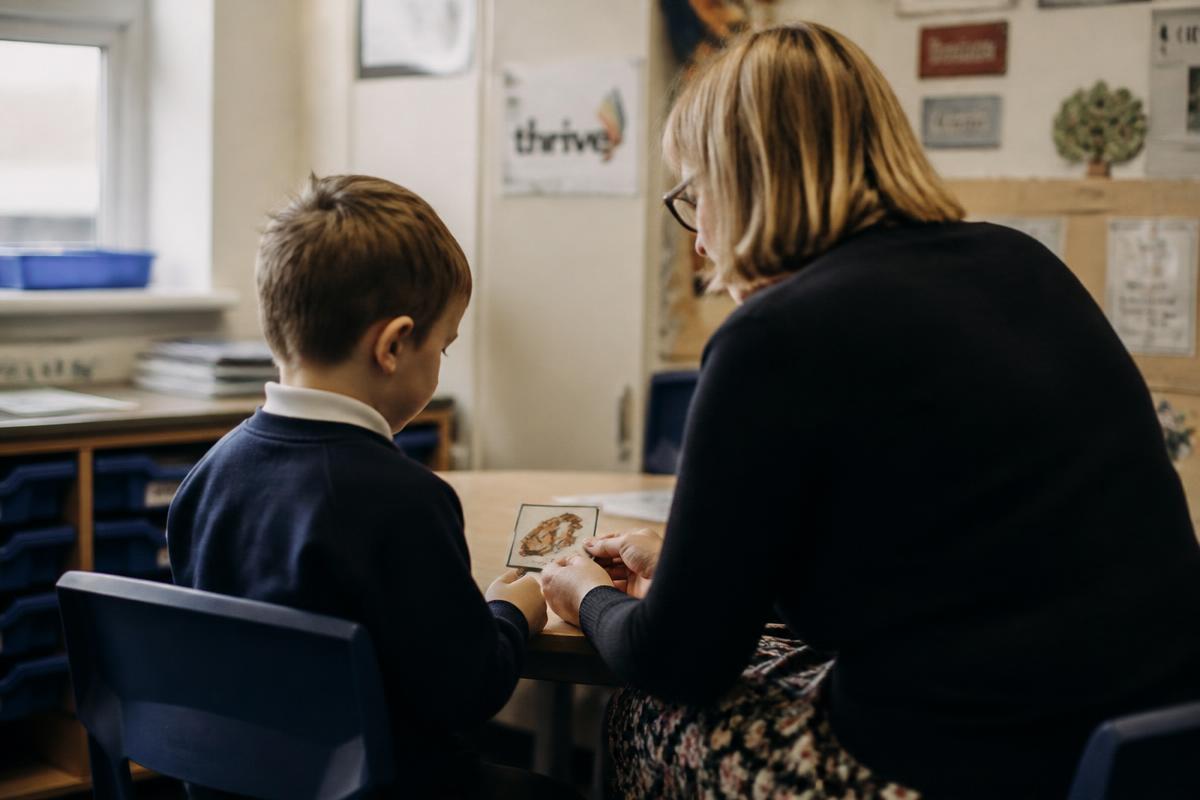
An adult and a young primary school child sitting side by side at a classroom table, looking together at a small picture card in soft window light.
Written for families

Plain English, no jargon. You don't need a teaching background to use this — just read the parts that feel useful and skip the rest. If something raises a question, your child's teacher or SENDCO is the best next step.

OverviewFor parents

What speech sounds and speech clarity mean

Speech sounds are the individual sounds we use to make words. They are made by the voice box, tongue, lips, teeth and jaw working together, very fast, in the right order. Speech clarity — sometimes called intelligibility — simply means how easily other people can understand what your child says.

Speech sounds are not letters. Speech and Language UK give a helpful example: the word 'sheep' has five letters but only three sounds — 'sh', 'ee', 'p'. That is why a child can know their letters and still find some sounds hard to say.

In one sentence

Clarity is about how a child's speech sounds to a listener. It is not a measure of their intelligence, their understanding, their effort or their behaviour.


MoreFor parents

How speech develops

Children learn speech sounds gradually, usually in a broadly similar order. Sounds made at the front of the mouth, such as 'b', 'm', 'p' and 'd', tend to come early. Later sounds — 'sh', 'ch', 'th', 'r', and clusters like 'spl' in 'splash' — often take until the infant or lower junior years to settle.

Along the way, most children simplify words in predictable ways: 'tat' for cat, 'gog' for dog, 'poon' for spoon. These patterns are a normal part of learning, and most fade on their own.

Different rates, not a race

NHS speech and language therapy services and Speech and Language UK both stress that children reach these stages at different ages. Age guides are a reference point, not a test your child passes or fails.

OverviewFor parents

What you might notice

  • Familiar people understand your child easily, but people outside the family often do not.
  • Certain sounds are always swapped for another one, or left out of words.
  • Longer words come out shorter — 'nana' for banana, 'efant' for elephant.
  • Your child repeats themselves, gives up, or says "never mind" when not understood.
  • They talk less with unfamiliar adults or in bigger groups.
  • You find yourself translating for them.

Noticing these things does not mean something is wrong. It means you have useful information — and describing exactly what you notice is far more helpful to a professional than trying to name a condition.

MoreFor parents

Why some children's speech is harder to understand

There are several possible reasons, and often more than one is in play. Some children are still working through the normal pattern later than their friends. Some have had periods of reduced hearing — glue ear is common in young children and can make sounds muffled while it lasts. Some find the fine motor planning of speech genuinely hard. A few have a physical difference affecting the mouth, or a wider developmental picture.

Children growing up with more than one language are not more likely to have a speech difficulty. Sounds that do not exist in English may take longer to appear in English, which is a difference, not a disorder.

Please don't self-diagnose

Only a speech and language therapist can assess why a child's speech is unclear. Everything here is to help you describe what you see — not to arrive at a label.

MoreFor parents

Speech, language and communication are not the same

Speech

How the mouth, tongue, lips and voice physically produce sounds — how clear a child is to listen to.

Speech sounds

The individual sounds that make up words. Not letters: 'sheep' has five letters and three sounds.

Language

The words a child knows and how they put them together — understanding and expressing meaning.

Communication

Everything used to share meaning with someone else: words, gesture, expression, signs, symbols, turn-taking.

A child can be unclear to listen to and have excellent language. Another child can be perfectly clear and struggle to find words or follow instructions. Working out which is which changes what helps.

Support at homeFor parents

Practical ideas for home

Say it back the right way

"Tat!" — "Yes, a cat! A big cat." Your child hears the correct version without being told they got it wrong. Speech and language therapists call this recasting.

Don't ask for repetition drills

Making a child say a word again and again rarely fixes the sound and often makes them talk less. Leave targeted practice to a therapist's programme.

Face to face, unhurried

Get down to their level and give them your full attention. Being watched patiently is worth more than any technique.

Let them show you

Pointing, drawing, showing you the object or acting it out are all real communication. Accepting them keeps the conversation going.

Talk about what you are doing

Everyday narration — cooking, walking, tidying — gives lots of natural repetition of sounds and words with no pressure to perform.

Protect the confident places

Notice where your child talks most freely, and make more of that. Confidence is a big part of clarity.

MoreFor parents

When you do not understand your child

  • Repeat back the part you did understand: "You went to the …?" — this shows you are listening and narrows what is left.
  • Ask them to show you, point, or find it.
  • Offer a choice: "Was it the park or the shop?"
  • Ask for one word rather than the whole sentence.
  • If you still do not get it, be honest and kind: "I really want to know — can we come back to it?" Guessing wrongly again and again is more disheartening than admitting it.
Never pretend

Nodding along when you have not understood teaches a child that talking to you does not really work.

Support at homeFor parents

Things to avoid

  • Correcting sounds repeatedly in the middle of conversation — the message becomes 'how you say it matters more than what you say'.
  • Asking a child to perform their speech for relatives.
  • Telling them to slow down or try harder; effort is rarely the issue.
  • Speaking for them when they were managing.
  • Waiting silently for a long time because someone said they would grow out of it — many do, but a conversation with school or your GP costs nothing.
MoreFor parents

When to ask for advice

It is reasonable to ask for advice at any point — you do not need to reach a threshold first. It is particularly worth doing when your child is much harder to understand than others the same age, when they are frustrated or withdrawing from talking, when clarity has stopped changing over several months, or if you have any concern about their hearing.

  • Speak to your child's teacher or the SENDCO, and describe examples.
  • Ask your GP or health visitor about a hearing check — recent or repeated ear infections make this more important.
  • NHS children's speech and language therapy is the service that assesses speech sounds. In many areas families can refer themselves; your GP, health visitor or school can tell you the local route.
  • Waits vary considerably between areas, so it is worth asking early rather than waiting to be sure.
How to weigh this evidence

Speech sound development is well described and the broad order sounds emerge is consistent across sources. What is far less certain is which classroom activity helps which child — targeted speech sound work is a clinical intervention, and the strongest evidence sits with speech and language therapists rather than with school programmes. We found no NICE guideline specific to children's speech sound disorders, so clinical points here lean on RCSLT and NHS guidance.

ResearchFor parents

Further resources

  • Speech and Language UK — Ages and stages, and their family advice pages.
  • RCSLT — public information on speech sound disorders.
  • NHS — your local children's speech and language therapy service; search your area plus 'children's speech and language therapy'.
  • NHS — Glue ear, if hearing may be part of the picture.
ResearchFor parents

Evidence & Sources

  1. Royal College of Speech and Language TherapistsProfessional guidance
    Speech sound disorders — clinical guidance (updated 2024)

    The UK professional reference point. Explains that 'speech sound disorder' is an umbrella term used when a child's speech is much harder to understand than other children of the same age speaking the same language, and that sub-types differ in cause and in what helps.

  2. Royal College of Speech and Language TherapistsProfessional guidance
    Position paper on Childhood Apraxia of Speech (CAS) (2024)

    Relevant only to a small minority of children. Useful for understanding why a few children need specialist, high-frequency motor-speech input rather than general classroom support.

  3. Speech and Language UKProfessional guidance
    Speech sounds (resource library for educators)

    Plain-English explanation for school staff, including the point that speech sounds are not letters — 'sheep' has five letters and three sounds.

  4. Speech and Language UKProfessional guidance
    Ages and stages

    Typical development by age band, with the standing caveat that children reach these stages at different rates. Use as a reference point, never as a checklist to score a child against.

  5. NHS (Berkshire Healthcare NHS Foundation Trust)Professional guidance
    Typical speech sound development

    NHS speech and language therapy advice on the order sounds usually emerge — early sounds such as b, m, d before later ones such as 'ch', 'th' and clusters. Local NHS services publish similar pages; referral routes vary by area.

  6. NHSProfessional guidance
    Glue ear

    Common in young children and can affect hearing while it lasts. One reason a hearing check is a sensible first step when speech is unclear.

  7. Department for EducationStatutory guidance
    SEND Code of Practice: 0 to 25 years (2015)

    Places speech, language and communication within the communication and interaction area of need, and sets out the graduated approach — assess, plan, do, review — schools must follow.

  8. Department for EducationStatutory guidance
    Early years foundation stage statutory framework (current version)

    Communication and language is a prime area; settings must provide a language-rich environment and back-and-forth interaction.

  9. Department for EducationProfessional guidance
    The reading framework: teaching the foundations of literacy (2021, updated 2023)

    Relevant because phonics teaching and assessment rest on hearing and producing sounds. It sets out how to teach and check phoneme–grapheme correspondence, which is where unclear speech can be misread as a phonics gap.

  10. Education Endowment FoundationResearch summary
    Preparing for Literacy: improving communication, language and literacy in the early years (2018)

    Recommends high-quality adult–child interaction and developing children's speech, language and communication. It is about the language environment, not about treating speech sound difficulties — that sits with speech and language therapy.

  11. Education Endowment FoundationResearch summary
    Improving Literacy in Key Stage 1 (2017, updated)

    Places phonological awareness and language capability among the foundations of early reading and writing.

  12. I CAN and RCSLTResearch summary
    Bercow: Ten Years On — an independent review of provision for children and young people with SLCN in England (2018)

    Documents variable identification and long waits for speech and language therapy in England, and argues for communication being everybody's business rather than a specialist add-on.

Supporting School
Curious how school approaches speech sounds & speech clarity?

The professional Evidence Library shows the same ideas written for teachers, SENDCOs and school leaders.

Open the Evidence Library
Continue exploring

Where to go next.

A calm handful of next steps — not a checklist. Follow whichever thread is most useful right now.

Related guides

A natural next thread.

For the classroom

What school is doing.

See the same evidence translated for teachers, so home and school can pull in the same direction.

Browse by theme

Zoom out.

Sensory, attention, communication, wellbeing — see how this topic sits alongside the wider picture.

Learning pathway

Take the longer route.

Working memory, attention, executive function and cognitive load — threaded into one guided journey.

You may also find these helpful

Related Evidence Guides

Each guide below connects to the one you've just read. We've noted why — so you can follow the thread that matters most to you.

A stack of well-loved picture books beside a notebook on a wooden desk in soft window light.
Evidence guide · 12 min read

Working Memory

The mental notepad that lets a child hold information in mind long enough to use it — and the small changes that make the biggest difference.

Explore
A pegboard on a classroom wall with wooden name tags in warm afternoon light.
Evidence guide · 14 min read

Executive Function

Planning, flexibility and impulse control — the mental machinery that lets a developing brain get things done.

Explore
An open book and pencil on a classroom desk lit by low morning sunlight through a window.
Evidence guide · 11 min read

Attention

What we mean by attention, why it wanders, and the classroom conditions that help it hold.

Explore
A quiet primary classroom corner with soft natural light, uncluttered surfaces and calm materials.
Evidence guide · 11 min read

Cognitive Load

How lesson design shapes what a working memory can carry — and the small design choices that free up thinking for learning.

Explore
A child's small hands holding an autumn maple leaf in soft window light.
Evidence guide · 10 min read

Processing Speed

Why this is relevant

Rehearsing and repairing an unclear message takes time; extra thinking time protects participation.

Explore
A teacher crouched at eye level beside a young child at a classroom desk, pointing at a small visual card in soft window light.
Evidence guide · 13 min read

Understanding Spoken Language

Why this is relevant

Clarity is about output; this guide covers what a child takes in — the two are often confused and need different support.

Explore
A young primary school child talking animatedly to an adult across a classroom table in soft window light.
Evidence guide · 14 min read

Expressive Language

Why this is relevant

Finding and ordering words is separate from saying them clearly; many children need both looked at together.

Explore
An adult and a young primary school child sitting side by side over an open picture book in soft window light.
Evidence guide · 14 min read

Vocabulary & Word Knowledge

Why this is relevant

Unclear speech can hide the words a child actually has — word knowledge needs checking in ways that do not rely on clarity.

Explore
A quiet primary school book corner with a wooden bench, cushions and a basket of picture books beside a window in soft daylight.
Evidence guide · 15 min read

Emotional Regulation

Not the ability to stay calm. What emotional regulation actually involves, how it grows through relationships, and what genuinely helps at home and in class — with the strength of the evidence stated plainly.

Explore