Evidence Guide
13 min read

Understanding Spoken Language

How children make sense of what adults say — and what we can change about the way we communicate so that more children understand, participate and show what they know.

Reading time
13 min read
Age range
All primary (EYFS–KS2)
Evidence level
High
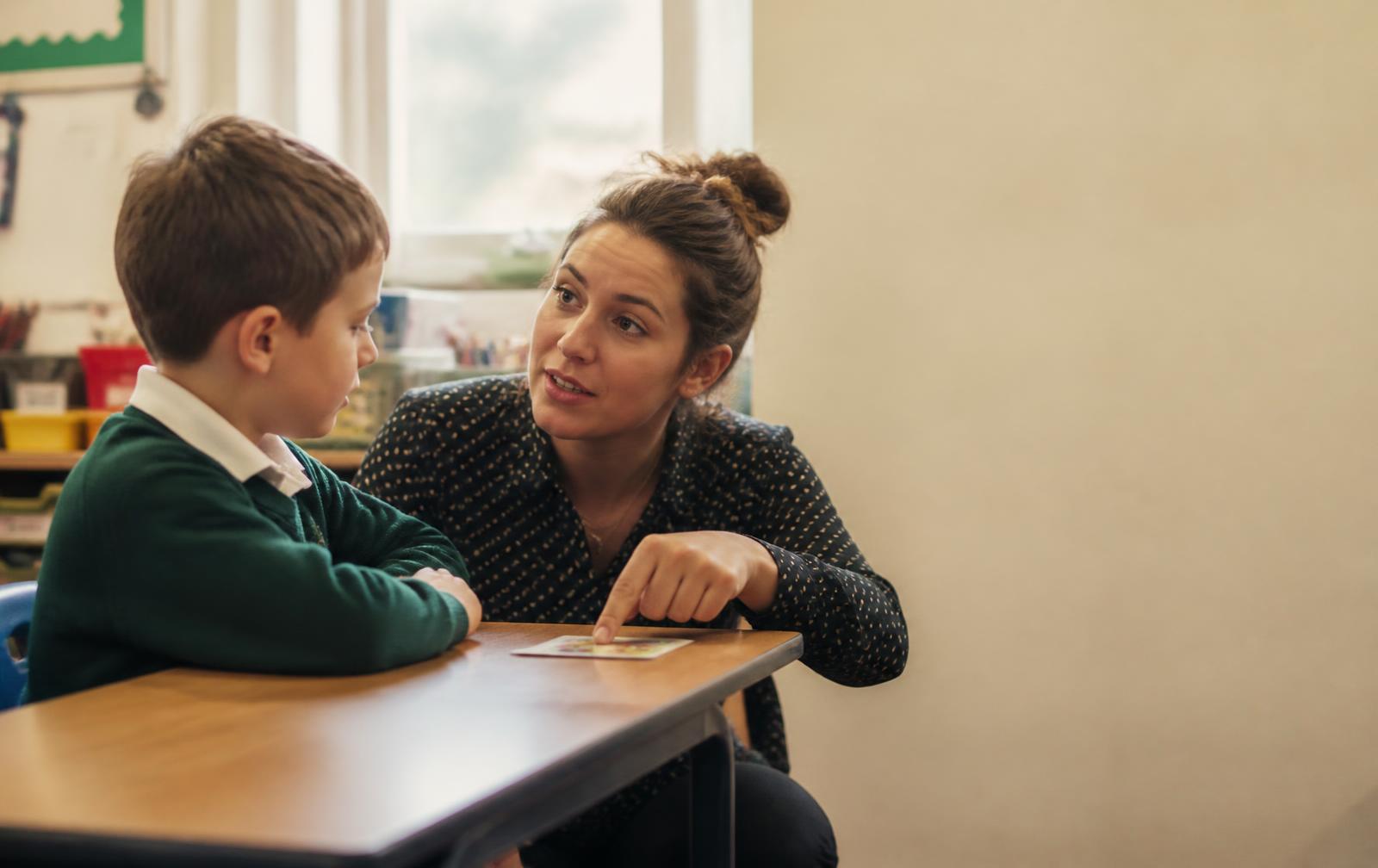
A teacher crouched at eye level beside a young child at a classroom desk, pointing at a small visual card in soft window light.
Written for families

Plain English, no jargon. You don't need a teaching background to use this — just read the parts that feel useful and skip the rest. If something raises a question, your child's teacher or SENDCO is the best next step.

OverviewFor parents

What understanding spoken language means

Understanding spoken language is the ability to make sense of what another person says — the words themselves, how they fit together, and what the speaker wants you to do. A child might hear every word and still not have understood the message.

Think about an instruction like: "Before you put your shoes on, grab your reading book and pop it in your bag." That single sentence contains an order of events, several objects and an expectation about what to do first.

In one sentence

Hearing and understanding are not the same thing — and when a child seems not to be listening, it is worth asking whether the words themselves were easy enough to follow.


Signs you may noticeFor parents

Signs you might notice at home

None of these on their own means a child has a difficulty. They are simply things worth noticing — and worth mentioning to school if you see them often.

  • Does the first part of what you asked, but not the rest.
  • Often asks "What did you say?" or "What do I do?"
  • Watches brothers, sisters or other children to work out what's happening.
  • Answers a slightly different question to the one you asked.
  • Gets confused by words with more than one meaning (a bat, a table, running late).
  • Understands much better when you show them as well as tell them.
  • Finds it much harder when the room is noisy or busy.
  • Can seem to switch off during long explanations.
Support at homeFor parents

Everyday examples

Getting ready in the morning

Three instructions at the door often become one remembered instruction. One step at a time, in the order it happens, works far better.

Talking about the school day

"What did you do today?" is a huge question. "Who did you sit next to at lunch?" gives a child something concrete to answer.

Board games and recipes

Rules and instructions are dense language. Showing one step and doing it together beats explaining all of it first.

Support at homeFor parents

Practical ideas to try

Get their attention first

Say their name, get down to their level, and wait until they're looking before you say the important part.

Say less

Short sentences, key words at the end: "Coat on." Then the next thing once that's done.

Show as well as tell

Point, demonstrate, or use a picture or written list. A second route into the meaning helps enormously.

Give thinking time

Count silently to ten before repeating. Many children need longer than we expect to process and reply.

Check gently

Instead of "Do you understand?", try "What are you going to do first?" — it tells you far more.

Repeat, don't rephrase

If they didn't get it, saying the same words again is often easier than a whole new sentence.

Support at homeFor parents

Things to avoid

  • Assuming that not following an instruction means not trying.
  • Long explanations while your child is already busy doing something else.
  • Piling up questions one after another before they've answered the first.
  • Reading a list of signs and concluding that your child has a particular condition — that is not something a checklist can tell you.
A note on diagnosis

Difficulties understanding language can have many causes. If you are worried, talk to your child's teacher or SENDCO, or your GP — they can help you think about next steps.

MoreFor parents

Working with school

Home and school observations are far more useful together than apart. If you have concerns, it can help to share:

  • What you notice at home.
  • Situations where communication is easier.
  • Situations where it becomes difficult.
  • Strategies that appear to help.
  • Changes you have noticed over time.
Remember

A child who struggles to understand spoken language is not necessarily being difficult, inattentive or deliberately ignoring you. Sometimes the language itself is the barrier.

MoreFor parents

Noticing whether things are getting better

If school makes changes to how they communicate with your child, progress usually shows up in small, everyday ways rather than in test scores.

  • Following instructions with less repetition.
  • Starting a task more independently.
  • Understanding and using new words.
  • Asking when they haven't understood.
  • Joining in with discussion more confidently.
  • Showing what they know, even when explaining is hard.
Ask your child

"What helps you understand instructions?" "What makes things difficult?" "Do you like being shown as well as told?" What a child says about what helps is real evidence, and schools should take it seriously.

Supporting School
Curious how school approaches understanding spoken language?

The professional Evidence Library shows the same ideas written for teachers, SENDCOs and school leaders.

Open the Evidence Library
Continue exploring

Where to go next.

A calm handful of next steps — not a checklist. Follow whichever thread is most useful right now.

Related guides

A natural next thread.

For the classroom

What school is doing.

See the same evidence translated for teachers, so home and school can pull in the same direction.

Browse by theme

Zoom out.

Sensory, attention, communication, wellbeing — see how this topic sits alongside the wider picture.

Learning pathway

Take the longer route.

Working memory, attention, executive function and cognitive load — threaded into one guided journey.

You may also find these helpful

Related Evidence Guides

Each guide below connects to the one you've just read. We've noted why — so you can follow the thread that matters most to you.

A stack of well-loved picture books beside a notebook on a wooden desk in soft window light.
Evidence guide · 12 min read

Working Memory

The mental notepad that lets a child hold information in mind long enough to use it — and the small changes that make the biggest difference.

Explore
A pegboard on a classroom wall with wooden name tags in warm afternoon light.
Evidence guide · 14 min read

Executive Function

Planning, flexibility and impulse control — the mental machinery that lets a developing brain get things done.

Explore
An open book and pencil on a classroom desk lit by low morning sunlight through a window.
Evidence guide · 11 min read

Attention

What we mean by attention, why it wanders, and the classroom conditions that help it hold.

Explore
A quiet primary classroom corner with soft natural light, uncluttered surfaces and calm materials.
Evidence guide · 11 min read

Cognitive Load

How lesson design shapes what a working memory can carry — and the small design choices that free up thinking for learning.

Explore
A child's small hands holding an autumn maple leaf in soft window light.
Evidence guide · 10 min read

Processing Speed

The pace at which a child takes in, makes sense of and responds to information — and why slower doesn't mean less capable.

Explore
A young primary school child talking animatedly to an adult across a classroom table in soft window light.
Evidence guide · 14 min read

Expressive Language

Why this is relevant

The other half of the picture: how children put their thoughts into words, and why output can lag far behind understanding.

Explore
An adult and a young primary school child sitting side by side over an open picture book in soft window light.
Evidence guide · 14 min read

Vocabulary & Word Knowledge

Why this is relevant

Understanding spoken language depends on knowing the words in it — an unfamiliar word is often where comprehension actually breaks.

Explore
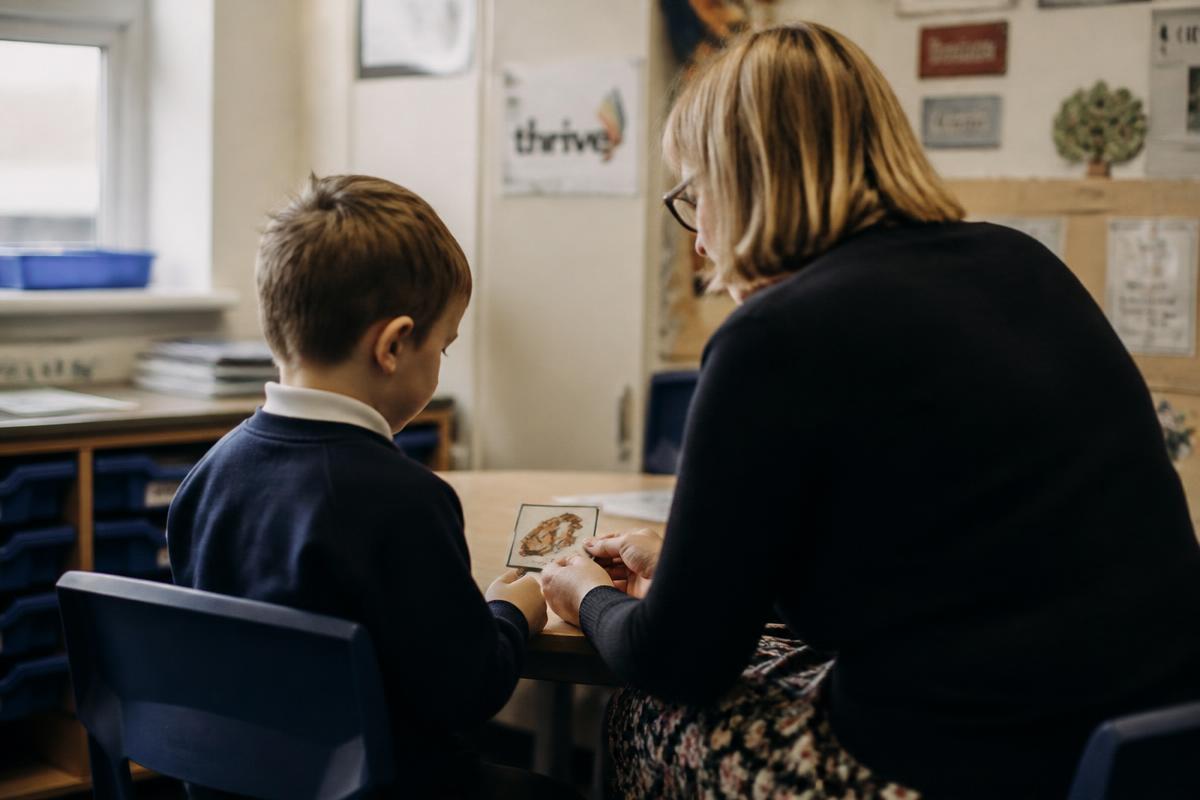
An adult and a young primary school child sitting side by side at a classroom table, looking together at a small picture card in soft window light.
Evidence guide · 14 min read

Speech Sounds & Speech Clarity

Why this is relevant

How clearly a child speaks says nothing about how much they understand — this guide keeps the two apart.

Explore
A quiet primary school book corner with a wooden bench, cushions and a basket of picture books beside a window in soft daylight.
Evidence guide · 15 min read

Emotional Regulation

Not the ability to stay calm. What emotional regulation actually involves, how it grows through relationships, and what genuinely helps at home and in class — with the strength of the evidence stated plainly.

Explore