Skip to content
Evidence Guide
16 min read

ADHD

Attention, impulse and activity are shaped as much by the situation as by the child. This guide looks at what ADHD is, what it is not, and what actually helps in a mainstream primary classroom and at home.

Reading time
16 min read
Age range
All primary (EYFS–KS2)
Evidence level
Moderate
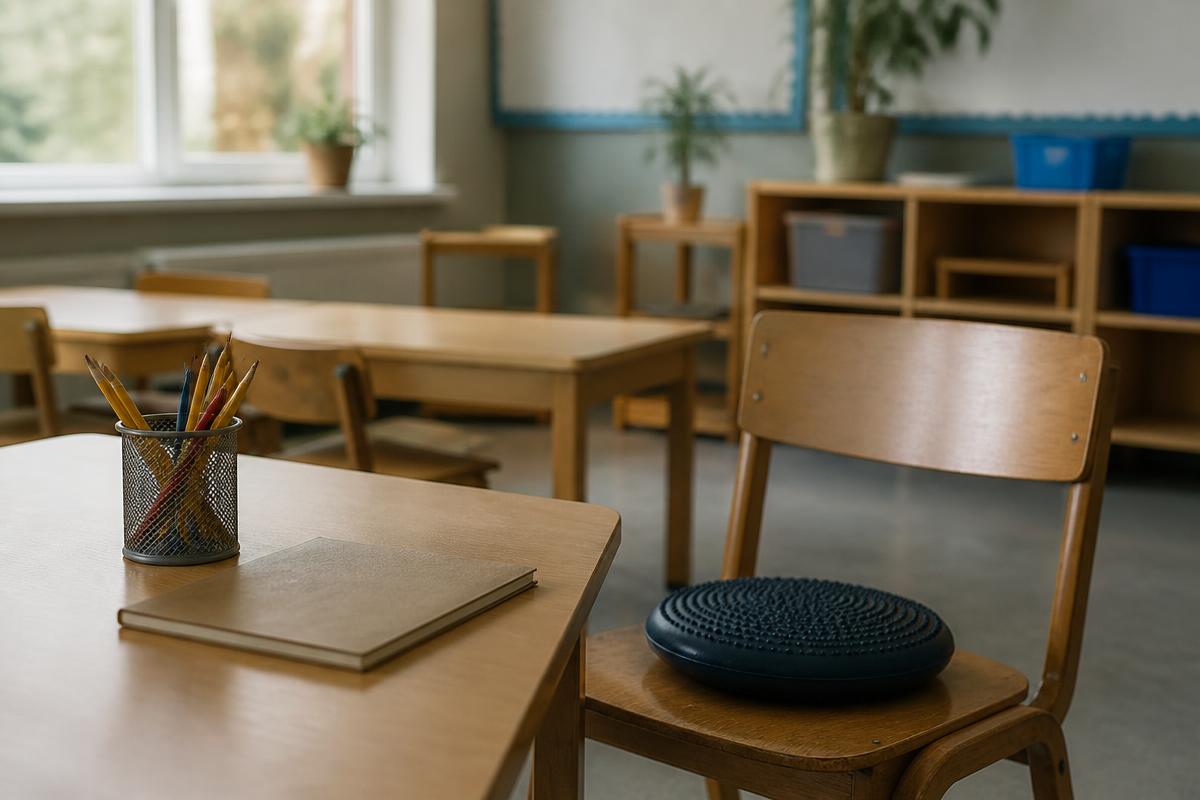
An empty primary school desk with a pencil pot and notebook beside a wooden chair with a wobble cushion, in soft morning light.
Written for families

Plain English, no jargon. You don't need a teaching background to use this — just read the parts that feel useful and skip the rest. If something raises a question, your child's teacher or SENDCO is the best next step.

OverviewFor parents

What ADHD is

ADHD — attention deficit hyperactivity disorder — is a neurodevelopmental condition. The NHS describes it as a difference in how the brain develops and works, present from early childhood rather than something a child acquires. It is usually described in terms of attention, impulsivity and activity level, and it often shows up in the everyday business of starting things, staying with them, waiting, and switching.

The name is not a very good description. Children with ADHD do not lack attention; attention is harder to direct and hold where it is needed, and can be extremely difficult to pull away from something absorbing. Interest, urgency, novelty and how a task is set up all change what is possible on a given day — which is exactly why the same child can look so different in two lessons.

One way to hold it

It is less "can they pay attention?" and more "how much does this situation ask of the systems that direct attention, hold information and delay a response — and how much of that can we take off the child?"

OverviewFor parents

What you might notice

These are observations, not a checklist and not a test. Every child does some of these. What matters is how often, how much it gets in the way, and whether it happens across different settings rather than only in one.

  • Instructions get lost part-way through, or only the last part is done.
  • Starting is the hard bit — even for things they want to do.
  • Deep, sustained absorption in something interesting, alongside real difficulty with anything that is not.
  • Movement: fidgeting, wandering, needing to be doing something with their hands or body.
  • Answers arrive before the question is finished; waiting a turn is genuinely uncomfortable.
  • Belongings, coats, bags and homework go missing regularly.
  • Feelings arrive fast and large, and pass quickly.
  • Mornings, bedtimes, homework and transitions are the hardest parts of the day.
  • Exhaustion or distress after school, when the effort of holding it together stops.
Many children do these things

Attention, activity and impulse control develop over years and vary hugely between children of the same age. Difficulty with them is common and is not, in itself, ADHD. Tiredness, anxiety, a language difficulty, hearing, sensory differences, unmet learning needs and simply finding the work too hard or too easy can all look similar from the outside.

MoreFor parents

Strengths are part of the picture

This is not a consolation paragraph. Adults who work well with children with ADHD tend to be the ones who know what the child is good at, because that is where the leverage is. Many children with ADHD bring energy, humour, willingness to try things, quick lateral thinking, deep engagement with what interests them, directness, and a strong sense of fairness. Some are noticing things nobody else in the room noticed.

None of this is universal, and none of it cancels out genuine difficulty. But a child who only ever hears about what they get wrong will draw conclusions about themselves that are much harder to undo than any of the practical problems.

OverviewFor parents

What differs between children

Presentation varies a great deal. Some children are visibly restless; others are quietly inattentive and drift through school without anyone raising a concern. It can look different at different ages, and it can look different at home and at school — which sometimes leads to each side thinking the other is exaggerating or being too soft. Usually both are describing what they genuinely see.

Context does a lot of work. Structure, interest, how tired a child is, how much noise there is, how clear the expectation is, how long the wait is, and whether an adult is nearby all change what happens. That is not evidence that a child could do it all the time if they tried harder; it is evidence that demands and environments matter.

AssessmentFor parents

Assessment and diagnosis: what it does and does not tell you

Only a suitably qualified health professional can diagnose ADHD. In England, that is usually a paediatrician or a specialist child mental health service, following a referral — often through your GP or, in some areas, via school. NICE NG87 sets out how recognition, referral and diagnosis should work, and assessment involves information from more than one setting, which is why school is asked to contribute.

  • A diagnosis can explain a pattern, open access to some services, and change how adults respond.
  • A diagnosis does not describe your child's strengths, or say what should happen in the classroom.
  • There is no single test. Assessment gathers information over time, from home and school.
  • Waiting lists in many areas are long. School support should not wait for the outcome.
  • A decision not to diagnose does not mean nothing is wrong or that you imagined it.
Support does not need to wait

Under the SEND Code of Practice, schools identify and respond to need. They do not need a diagnosis to make adjustments, and they should not be waiting for one.

OverviewFor parents

What helps at home

One instruction at a time

What it is: say one thing, wait for it to happen, then say the next. Why: it removes the memory step, which is often where things fall apart rather than at the willingness step.

Make the routine visible

What it is: a short picture or word list for mornings and bedtimes, in the place it happens. Why: the list does the remembering, and it becomes the thing being argued with rather than you.

Shorten the gap between doing and feedback

What it is: notice and say the thing now, not at the end of the week. Why: distant rewards do very little; immediate, specific acknowledgement does more.

Warn before you switch

What it is: a couple of minutes' notice before stopping something absorbing. Why: stopping mid-flow is genuinely hard, and warning converts an ambush into a plan.

Cut the homework into visible pieces

What it is: three short bursts with a clear finish line rather than one open-ended session. Why: the size of the task is often the barrier, not the content.

Let movement happen

What it is: a run, a scooter, jobs around the house, doing homework standing up. Why: many families find it helps, and it costs nothing. Be honest that this is practical wisdom rather than strong research evidence.

Protect the relationship

What it is: some part of the day that is not about instructions, correction or school. Why: children with ADHD receive far more negative feedback than their peers over a childhood, and that accumulates.

MoreFor parents

About the things you will see advertised

There is an enormous market around ADHD, and much of it is not evidence-based. We are not telling you to avoid everything — a fidget or a timer that helps your child is not a problem. We are saying be careful about what you spend money and hope on.

  • Fidget toys and sensory gadgets: some children find them useful, others find them a distraction. Evidence for improved learning is limited and mixed.
  • Movement breaks: widely used and often sensible, but the research base for improved attainment is weak. Judge it child by child.
  • Timers and visual countdowns: helpful for many children as a way of making time visible. Low cost, low risk.
  • "Dopamine hacks": a marketing phrase, not a clinical one. Treat the underlying advice on its own merits.
  • Supplements and special diets: NICE does not recommend eliminating foods or using supplements as a general treatment for ADHD. Speak to a health professional before restricting a child's diet.
  • Brain-training programmes: evidence of improvement in the trained tasks, little evidence that it transfers to classroom learning.
  • Anything promising to fix, cure or reverse ADHD: not supported by evidence.
On medication

Medication is a clinical decision, made with a specialist, and it is not something we advise on. NICE NG87 and the NHS set out when it is considered, alongside other support. It is neither a failure nor a shortcut, and it is not a substitute for adjustments at school.

MoreFor parents

Working with school

  • Ask for a conversation with the class teacher first, then the SENDCO if you need to.
  • Describe specific situations rather than general worry: which lesson, which part of the day, what happens.
  • Ask what they see — it may differ from home, and both pictures are needed.
  • Ask what is being put in place, and when you will review whether it is working.
  • Share what works at home; a lot of it transfers.
  • Ask how they will keep you informed without every message being about something going wrong.

If you are worried enough to want an assessment, your GP is usually the route, and school can contribute information. Say clearly what you are asking for and why.

ResearchFor parents

Evidence & sources

The label is the start of the conversation, not the end of it

A diagnosis tells you something real, and it can unlock understanding, services and self-knowledge. What it does not tell you is what this child needs on Tuesday morning in maths. Two children with the same diagnosis can need almost opposite things. The useful sequence is always: this child's strengths and profile → what is actually getting in the way → in which situations → what we can change or provide.

What this guide is, and is not

This is an educational resource, not a clinical one. Nothing here identifies, diagnoses or rules out ADHD — that requires a specialist assessment through the NHS or an equivalent qualified service. Many children find attention, activity or impulse control difficult without having ADHD, and some children with ADHD show none of the more obvious signs. We also do not give medication advice: where treatment is relevant, NICE NG87 and the NHS are the sources to follow.

  1. National Institute for Health and Care ExcellenceProfessional guidance
    Attention deficit hyperactivity disorder: diagnosis and management (NG87) (2018, last updated 2019)

    The NHS reference point for recognition, referral, diagnosis and management. Diagnosis requires a specialist assessment; NICE also sets out when environmental adjustments should be tried first.

  2. NHSProfessional guidance
    ADHD in children and young people

    Plain-English NHS information for families on characteristics, assessment routes and what support looks like. The right first link to give a parent.

  3. Department for EducationResearch summary
    Neurodivergence Task and Finish Group: report — recommendations for mainstream education (February 2026)

    Independent report to DfE. Recommendations, not statutory duties. Its four priorities — timely identification of strengths and needs, workforce development, learning environments and curriculum, and funding and accountability — describe the direction of travel.

  4. Department for Education / University College LondonResearch summary
    Identifying and supporting the needs of children with SEND in mainstream settings — rapid evidence assessments (September 2025)

    A series of DfE-commissioned reviews. Explicitly not government policy. Useful for what the evidence does and does not support in mainstream identification and provision.

  5. Department for EducationStatutory guidance
    SEND Code of Practice: 0 to 25 years (2015)

    Current statutory guidance. Sets out the graduated approach and makes clear that support follows identified need — a diagnosis is not a prerequisite for provision.

  6. Education Endowment FoundationResearch summary
    Special Educational Needs in Mainstream Schools — guidance report (2020, updated 2021)

    The five-a-day principles and the argument that high-quality teaching, not a separate strategy for each label, is the strongest lever available to schools.

  7. Education Endowment FoundationResearch summary
    Metacognition and Self-regulated Learning — guidance report (2018, updated 2021)

    Explicit teaching of planning, monitoring and evaluating. Relevant to organisation and task management, though the evidence is about teaching approaches generally rather than about ADHD specifically.

  8. Department for EducationProfessional guidance
    Behaviour in schools: advice for headteachers and school staff (2024)

    Expects schools to consider whether behaviour is linked to SEND and to make reasonable adjustments, alongside clear and consistently applied expectations.

Supporting School
Curious how school approaches adhd?

The professional Evidence Library shows the same ideas written for teachers, SENDCOs and school leaders.

Open the Evidence Library
Continue exploring

Where to go next.

A calm handful of next steps — not a checklist. Follow whichever thread is most useful right now.

For the classroom

What school is doing.

See the same evidence translated for teachers, so home and school can pull in the same direction.

Same category

More in Neurodevelopment.

ADHD, Autism, Dyslexia, Dyspraxia, sensory processing and related neurodevelopmental profiles.

You may also find these helpful

Related Evidence Guides

Each guide below connects to the one you've just read. We've noted why — so you can follow the thread that matters most to you.

A stack of well-loved picture books beside a notebook on a wooden desk in soft window light.
Evidence guide · 12 min read

Working Memory

Why this is relevant

Instructions getting lost part-way through is frequently a memory load issue — worth reading whether or not ADHD is in the picture.

Explore
A pegboard on a classroom wall with wooden name tags in warm afternoon light.
Evidence guide · 14 min read

Executive Function

Why this is relevant

Planning, starting and switching are areas some children with ADHD find harder. ADHD is not simply an executive function disorder, but this guide is often useful alongside it.

Explore
An open book and pencil on a classroom desk lit by low morning sunlight through a window.
Evidence guide · 11 min read

Attention

Why this is relevant

Attention is one area that can be relevant for some children with ADHD — this guide covers how it works and what supports it in class.

Explore
A quiet primary classroom corner with soft natural light, uncluttered surfaces and calm materials.
Evidence guide · 11 min read

Cognitive Load

How lesson design shapes what a working memory can carry — and the small design choices that free up thinking for learning.

Explore
A child's small hands holding an autumn maple leaf in soft window light.
Evidence guide · 10 min read

Processing Speed

Why this is relevant

Pace and thinking time affect what a child can show, and can look similar to attention difficulty from the outside.

Explore
A teacher crouched at eye level beside a young child at a classroom desk, pointing at a small visual card in soft window light.
Evidence guide · 13 min read

Understanding Spoken Language

How children make sense of what adults say — and what we can change about the way we communicate so that more children understand, participate and show what they know.

Explore
A young primary school child talking animatedly to an adult across a classroom table in soft window light.
Evidence guide · 14 min read

Expressive Language

How children put their thoughts, ideas, needs and experiences into words — and what adults can change so that more children can show what they think and know.

Explore
An adult and a young primary school child sitting side by side over an open picture book in soft window light.
Evidence guide · 14 min read

Vocabulary & Word Knowledge

What it means to really know a word, why word knowledge sits underneath so much classroom learning, and how adults can build it deliberately without turning language into a deficit.

Explore
An adult and a young primary school child sitting side by side at a classroom table, looking together at a small picture card in soft window light.
Evidence guide · 14 min read

Speech Sounds & Speech Clarity

Being hard to understand is not the same as having less to say. What speech sounds are, how clarity develops at different rates, and how to keep a child fully included while it does.

Explore
A quiet primary school book corner with a wooden bench, cushions and a basket of picture books beside a window in soft daylight.
Evidence guide · 15 min read

Emotional Regulation

Why this is relevant

Fast, large feelings are described by many families. This guide covers what regulation involves and how co-regulation helps.

Explore
A quiet primary school cloakroom with a single coat and book bag on a wooden peg rail in soft morning light.
Evidence guide · 15 min read

Anxiety & Worry

Most childhood worry is ordinary and passes. This guide is about telling the difference — what anxiety is, how it shows up when a child cannot name it, what genuinely helps, and when to involve someone else.

Explore
A quiet primary classroom carpet area with cushions and a low bookshelf in soft daylight.
Evidence guide · 16 min read

Understanding Behaviour

Why this is relevant

For how to read behaviour as information rather than intent, and how to respond in a way that is both understanding and clear.

Explore
An empty wooden bench beside a primary school playground with a faded chalk hopscotch grid and autumn leaves.
Evidence guide · 15 min read

Relationships & Belonging

Why this is relevant

Friendship and standing in the class are often where the cost is felt most. This guide covers what schools can change.

Explore
A quiet corner of a primary classroom with a low wooden shelf of neatly arranged wooden blocks and a folded blanket beside a window.
Evidence guide · 17 min read

Autism

Autism is a difference in how a person communicates, experiences the world and makes sense of it — not a list of deficits. This guide looks at what may be relevant, what the environment contributes, and what genuinely helps in a mainstream primary school.

Explore
An open book resting on a wooden primary school table beside a pencil and reading glasses in soft window light.
Evidence guide · 16 min read

Dyslexia

Dyslexia is about accurate, fluent word reading and spelling — not reversed letters or a visual learning style. This guide separates what is known from what is myth, and sets out the teaching and adjustments that actually help.

Explore
An adult's hand gently holding a young child's hand in soft natural light.
Evidence guide · 13 min read

School Attendance

When getting to school becomes the hardest part of the day. What can sit underneath attendance difficulties, how families and schools can work on it together, and what the guidance actually expects.

Explore
A calm, quiet reading corner in a primary classroom with cushions and soft daylight.
Evidence guide · 11 min read

Transitions

Moving from one thing to the next — between activities, places, people and years. Why change can be so hard for some children, and the calm, predictable preparation that helps.

Explore
Soft natural textures and calm materials arranged in gentle daylight.
Evidence guide · 11 min read

Sensory Needs

Some children experience noise, light, touch, smell or movement more — or less — intensely than others. What that can look like, why it matters for learning and wellbeing, and the calm adjustments that help.

Explore
A tidy wooden desk with a notebook and pencils in soft window light.
Evidence guide · 9 min read

Homework

Making home learning calmer for everyone. What the evidence says about primary homework, why it can be so hard after a long school day, and how families and schools can keep it purposeful rather than painful.

Explore
A parent and child sharing a picture book together in soft, warm light.
Evidence guide · 9 min read

Sleep

Small, steady changes that help a child settle and stay asleep — and why sleep matters so much for learning, mood and coping. Based on NHS advice.

Explore